
Non-Verbal Communication: Do Gestures Really Speak Louder Than Words?

You say “I’m fine” with a big smile, but your arms are crossed and your eyes keep drifting to the door. Which message will the other person believe? Non-verbal communication isn’t magic: you can observe it, question it and get better at it. Here’s how to read gestures without falling for the clichés, what the research really says, and three small exercises to try this week.
The short version
- The famous “55% non-verbal” figure only applies to very specific situations. It doesn’t mean words matter little.
- A single gesture says almost nothing: read a cluster of signals, in context.
- When words and body contradict each other, people tend to doubt the message, so try to line them up.
- Touch can soothe, but it needs consent and context.
Non-verbal communication: what the “55%” figure really means
You’ve probably seen it: 55% of communication is body language, 38% is tone of voice and just 7% is words. That number comes from two small studies by psychologist Albert Mehrabian, published in 1967. They looked at single spoken words, delivered in a certain tone or paired with a face, to judge positive or negative feelings.
Mehrabian himself says the percentages only apply when someone is talking about their feelings or attitudes and their signals clash. In any other situation they don’t apply. So no, your presentation or a chat with your sister is not 93% decided by your posture.
What does hold up is that your body colours what you say. A kind sentence delivered in a clipped tone doesn’t sound kind. Gestures, eye contact and voice add a layer of intention and emotion to your words, but they never replace them.
Reading a gesture without getting it wrong
It’s tempting to turn every movement into a verdict: crossed arms mean closed off, a hand on the face means lying. In real life, someone with crossed arms may simply be cold, have a sore back or just stand that way. To limit mistakes, keep three habits in mind.
- Look at several signals together: eyes, face, posture, voice. One clue proves nothing.
- Compare with the person’s baseline: someone who talks with their hands and suddenly goes still tells you more than a shy person who stays quiet.
- Factor in the setting: a waiting room, a job interview and a family dinner don’t produce the same reactions.
Mini-exercise (3 minutes): in your next conversation, pick one person and make a mental note of what they do when they’re relaxed. A few minutes later, see what changes when the topic gets delicate. You’re learning to spot shifts, not to stick labels on people.
Four families of gestures
To find your bearings, gestures are often sorted into four families. They’re guidelines, not laws: meanings vary from culture to culture and from person to person.
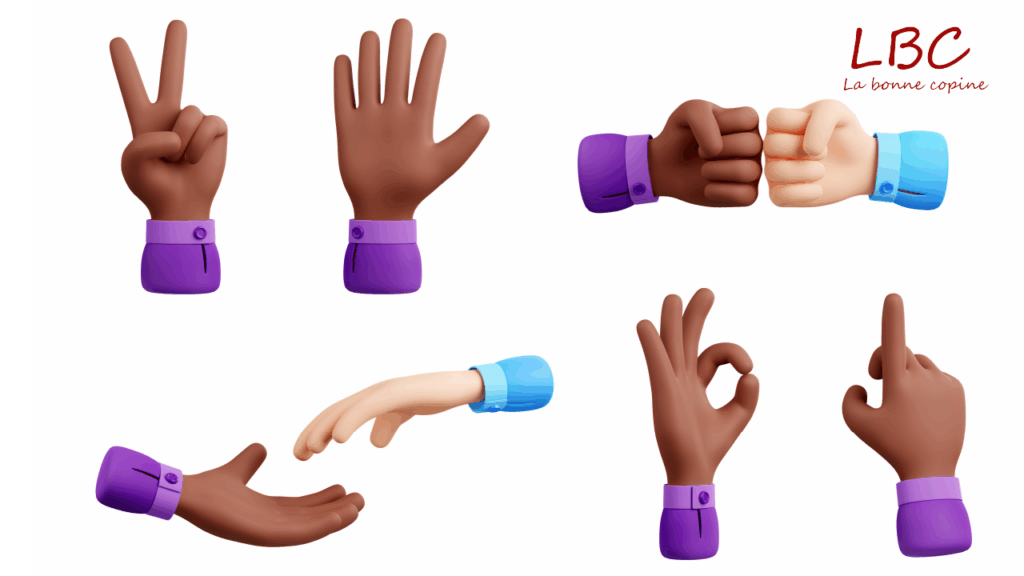
- Open and closed gestures: visible palms and relaxed shoulders often go with availability, while crossed arms or a hunched body suggest caution or distance. They can also just mean tiredness or a cold room.
- Fidgeting gestures: touching your face, clicking a pen, rocking on your feet. They often reveal tension or emotion, without saying where it comes from.
- Illustrative gestures: showing a size with your hands, pointing. They go along with speech and make it clearer.
- Eyes and smile: they signal attention, warmth or discomfort. A polite smile and a smile that reaches the eyes aren’t the same, but reading them is always a matter of nuance.
Bear in mind that the same gesture can mean different things in different countries. A sign that seems harmless at home can look rude elsewhere. If you travel or work with people from other cultures, ask, observe, adjust rather than assume.
When gestures contradict words
Picture this: you ask a friend how she is and she says “great” while staring at her phone, shoulders hunched. You don’t quite believe her, and you’re right to sense a gap. That gap doesn’t prove she’s lying. It’s an invitation to ask one more question.
In that moment, skip the cross-examination. You could say: “You seem a bit far away. Do you want to talk, or shall we get some fresh air?” You name what you notice, you offer a choice, and you don’t draw conclusions on her behalf.
It works the other way round too. When you say “fine” through gritted teeth, the people around you pick it up. Before an important conversation, take ten seconds to drop your shoulders, breathe and rest your hands. Your words are more likely to land the way you mean them.
Mini-exercise (2 minutes): in front of a mirror or on a video call, say out loud an important sentence you’ll soon need to deliver. Watch your face and hands: do they say the same thing as your sentence? If not, adjust one thing at a time.
Touch: what James Coan’s study actually shows
You’ll often read that a hand on the shoulder or a hug “proves” lower stress. The research is more nuanced. In 2006, James Coan, Hillary Schaefer and Richard Davidson published an fMRI study in Psychological Science involving 16 married women who were expecting a mild electric shock.
They were tested while holding their husband’s hand, a stranger’s hand or no hand at all. Holding the husband’s hand dampened threat-related brain activity more broadly than holding a stranger’s, and the effect was stronger in women who were happiest in their marriage. The authors point out that the sample is small and made up of very satisfied couples, so the results can’t be generalised to every relationship.
What you can take from it without overstating: contact from someone you trust may help you feel less threatened. This study can’t be used to promise a specific effect on oxytocin or blood pressure, though. And touch only makes sense when it’s welcome: ask, watch the reaction, and respect a “no”, even an unspoken one.
At work and in social settings: what we actually know

In the workplace, a study by Joep Cornelissen is often quoted to claim that gestures persuade more than words. What it shows is more modest. Published in 2012 in the International Small Business Journal by Joep Cornelissen, Jean Clarke and Alan Cienki, it follows two entrepreneurs to see how they make sense of their venture for others, through both speech and gesture.
The abstract describes metaphors appearing in words as well as gestures, but it doesn’t compare the effect of gestures and words on investors. So be careful with the shortcut that “gestures outweigh speech”. What we can say is that speech and gesture work together to make an idea clear.
For a meeting, an interview or a talk, here’s what helps in practice:
- Let your hands talk: natural gestures at chest height help illustrate your point.
- Rest your eyes on each person for a few seconds, rather than sweeping the room or staring at your notes.
- Spot your fidget (hair, pen, jewellery) and swap it for a pause: resting your hands flat is enough.
- Adapt to the culture and the room: some teams are very expressive, others far more reserved.
A one-week practice plan
You don’t have to change everything. Pick one focus a day and jot down, in the evening, what you noticed without judging yourself.
- Monday: notice how you sit. Where are your shoulders and hands?
- Wednesday: spot one fidgeting habit, without trying to get rid of it.
- Friday: in a conversation, name what you pick up in the other person with an open question, such as “you seem preoccupied, are you okay?”.
- Sunday: reread your notes and choose one small adjustment to keep for next week.
To see how these signals work inside a relationship, our article on how non-verbal communication can deepen your connections takes the topic into closer, more personal territory. For confidence at work, simple gestures to gain assurance in your professional life offers another angle on posture, and our guide to non-verbal signs of seduction shows how the same reading skills apply when you’re trying to work out whether someone is interested.
When to ask for help
Reading signals doesn’t make you a therapist, and it isn’t a way to diagnose anyone. If someone close to you withdraws for a long time or seems deeply distressed, or if you feel very anxious in social situations yourself, talk to your GP or a psychologist. If there’s immediate danger, contact the emergency services in your country.
So, which signal will you watch first?
The body doesn’t always lie, and it doesn’t always tell the truth either: it tells part of the story, and words complete it. Rather than trying to decode everything, practise noticing, nuancing and asking. Which small gesture will you observe this week, in yourself or in others?
Sources consulted on 28/10/2026: Albert Mehrabian, overview of his 1967 work and his clarifications on the scope of the “7-38-55” rule (Wikipedia, “Albert Mehrabian”); Coan, Schaefer and Davidson (2006), “Lending a Hand: Social Regulation of the Neural Response to Threat”, Psychological Science, vol. 17, no. 12 (abstract); Cornelissen, Clarke and Cienki (2012), “Sensegiving in Entrepreneurial Contexts: The Use of Metaphors in Speech and Gesture to Gain and Sustain Support for Novel Business Ventures”, International Small Business Journal, vol. 30, no. 3 (abstract).