The pressure to perform: why optimisation is making us unhappy

Our obsession with the pressure to perform doesn’t make life better — it shrinks it. That’s the finding of several researchers in psychology and neuroscience, confirmed by recent data: in France, almost one young person in five now suffers from anxiety or depression (University of Rouen, 2024).
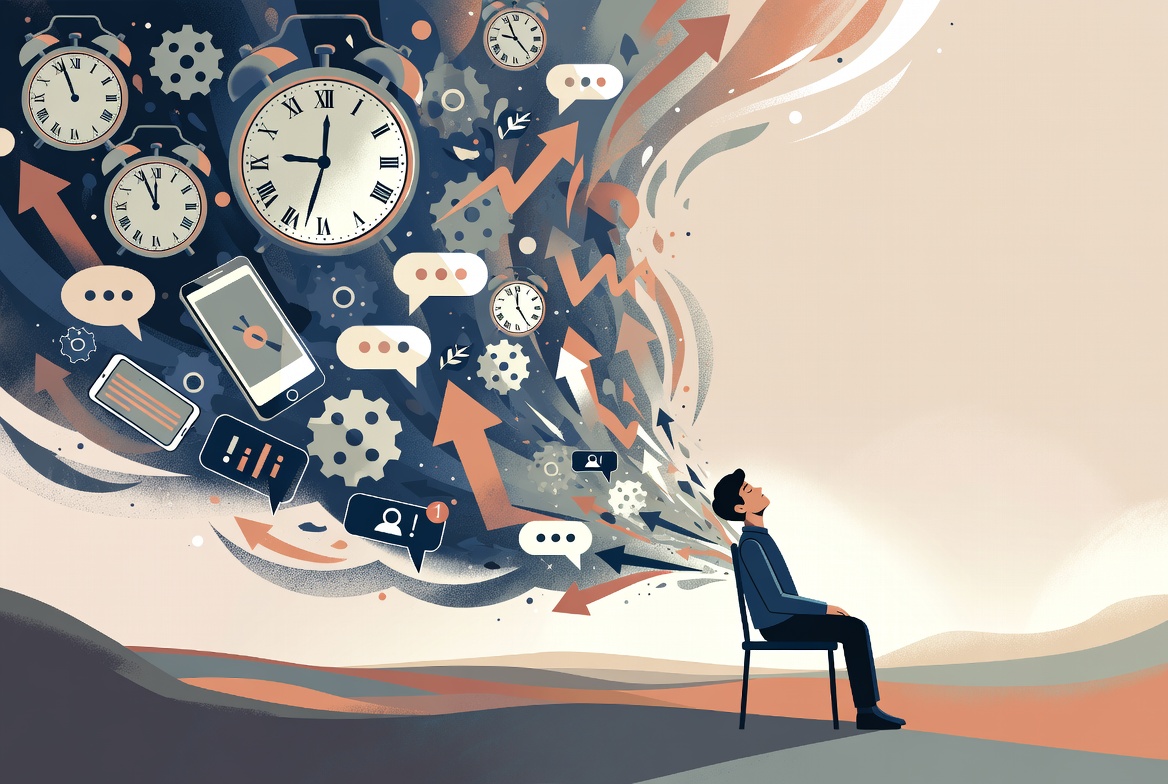
And yet this compulsion to constantly improve ourselves is not a natural human trait. It’s a precise historical legacy, born in the factories of the Industrial Revolution, which has gone on to colonise our diaries, our screens, and even the way we rest.
Infographic “The pressure to perform”: from its industrial origins to its impact on young people’s anxiety, and an invitation to consider that “enough” might just be enough.
In this essay, we deconstruct the pressure to perform to ask one essential question: what if “enough” really were enough?

1: The essentials at a glance
| What the research says | What it means for you |
|---|---|
| Satisfaction returns to its baseline level after every success (hedonic treadmill, 1971) | Chasing the next goal doesn’t fill the void — it just moves it |
| +3h30/day on social media among 15–24 year-olds | Digital social comparison amplifies the anxiety of never being “enough” |
| The brain needs “unproductive” time to regulate emotion | Idleness isn’t a luxury — it’s a neurological function |
| Flow (Csikszentmihalyi) comes from the pleasure of doing, not the outcome | Change the engine, not the goal |
Article updated: January 2026.
2: Historical origins: how the pressure to perform colonised our time
Before the 18th century, the very idea of “wasting time” was almost absent from collective thought. Time was simply lived — paced by the seasons, by religious rites, by meals shared together.
The break came with the British Industrial Revolution (1760–1840). Clocks appeared in factories. Frederick Winslow Taylor broke work down into measurable units. Every minute became a resource — and therefore a resource that could be squandered.
What remains striking is the speed at which this factory logic escaped the factory. In under two centuries, it colonised private life, holidays, weekends. Today, admitting you “did nothing” on Sunday triggers a social unease that saying you “ate nothing interesting” simply doesn’t.
Our diaries have become a battlefield. Every empty slot is seen as a missed opportunity to be productive — to read something useful, to move a project forward, to optimise something. Oliver Burkeman’s point in Four Thousand Weeks is a sharp one: we don’t have a time-management problem, we have a problem with our relationship to finitude. And no productivity app fixes that.
3: The trap of “the best version of yourself”
The project is seductive. It’s also mathematically impossible.
Neuroscientist Albert Moukheiber calls it “neuromania” — the tendency to believe that with the right hack, the right diet, the right morning routine, you can reprogramme your brain to excel at everything. The problem isn’t ambition. It’s the arithmetic.
Opportunity cost is a physical reality, not a metaphor, and it’s the invisible engine behind the pressure to perform. Every hour devoted to professional excellence is an hour physically absent from your love life, your sleep, or simple idleness. Total excellence can’t be managed — it can only be partially chosen, at the expense of everything else.
There’s another, subtler trap: even when you get there, it doesn’t last. The hedonic treadmill phenomenon (Brickman & Campbell, 1971) shows that our level of satisfaction very quickly returns to its baseline after a success. The promotion landed, the kilo lost, the project delivered — the joy lasts a few days. Then attention shifts to the next milestone.
This isn’t a character flaw. It’s a brain adaptation mechanism. But understanding this changes something: if no achievement “satisfies” us for long, maybe the problem isn’t our achievements at all.
4: Young people — and the algorithmic surveillance of merit
The impact on younger generations deserves particular attention, because it goes well beyond the usual talk about “screens”.
In France, 17.2% of young people suffer from an anxiety or depressive disorder (University of Rouen, 2024). That figure coincides with a generation that has grown up with a permanent mirror, where the pressure to perform is measured in likes and views: social media doesn’t just show what other people are doing — it scores what you do. The number of likes, views and followers turns identity-building into a form of continuous public performance, which Quebec’s Order of Psychologists identifies as a major driver of anxiety.
But the mechanism doesn’t only affect teenagers.
Parents feel trapped too. Well aware of the harmful effects of overperformance, they still overload their children’s schedules — sport, languages, extracurricular activities — out of fear of a social decline perceived as a collective punishment. The pressure is passed down vertically, before a child can even tell the time.

5: Experience Layer: what we’re actually seeing around the pressure to perform
Observations drawn from testimonies gathered on French-language forums (Reddit r/france, Maman Travaille, parenting Facebook groups), January–February 2026.
A striking pattern recurs in the accounts of working women with children: the guilt doesn’t come from having done something wrong — it comes from having optimised less than planned. “I should have finished the report tonight”, “I could have done 20 minutes of exercise during nap time”. Idle time is no longer neutral — it’s weighed down by what it “could have been”.
Something else we’ve noticed: the women who break out of this cycle most easily aren’t the ones who’ve “learned to relax” — they’re the ones who’ve changed their physical or social environment. Fewer notifications. One non-negotiable screen-free hour. A dedicated workspace that closes at a set time.
Our honest verdict: advice along the lines of “accept your imperfection” rarely works on its own. What works is a small, concrete structural change — not an inner revolution.
6: Practical steps — changing your compass, without the idealism
Four approaches with real substance, beyond the usual platitudes.
- Accepting the statistics of the average is the first step towards defusing the pressure to perform. Most of us sit somewhere in the middle on most dimensions. That’s not a depressing conclusion — it’s a release from the demand to be exceptional. In his In Praise of Idleness, Bertrand Russell already argued that “happy mediocrity” was both socially undervalued and personally under-practised.
- Distinguishing flow from pressure. Mihaly Csikszentmihalyi spent decades documenting a simple idea: deep satisfaction comes from total immersion in an activity for the pleasure of doing it, regardless of the outcome. That’s not the same as working hard towards a goal. Flow requires the absence of judgement about performance — precisely what the optimised diary systematically destroys.
- Rehabilitating the brain’s “default mode”. “Unproductive” time isn’t empty. Neuroscience identifies the Default Mode Network as the network activated during moments of daydreaming — and it’s precisely this network that processes emotions, generates creativity and consolidates memory. Banning this mode from the brain shuts down an essential function.
- Changing your environment before changing your mindset. An ergonomic chair, an uncluttered desk, a minimalist note-taking tool — concrete physical adjustments that reduce cognitive friction without requiring a prior inner transformation.
💡 eBoons tip: If you’d like to support Deep Work without the anxiety-inducing digital distractions, the reMarkable tablet (partner link) is one of the most stripped-back tools on the market — no notifications, no internet, just a writing surface. Buying through our link supports our work at no extra cost to you. That said, a notebook and pen do exactly the same job — and that’s just as valid a choice.
7: FAQ — Everything you need to know about the pressure to perform and flow
Does the concept of flow apply when you have little free time?
Yes — and that’s actually when it’s most useful. Flow doesn’t require long stretches of free time. It requires a moderately challenging activity, a clear goal, and no interruptions. Twenty minutes of focused cooking can produce more satisfaction than an hour of scattered work
Is idleness really achievable with a full-time job and children?
Honestly: not always, and not in large amounts. But the point isn’t to reclaim hours — it’s to change the texture of what you do. A walk without a podcast. A meal with the phone left off the table. Idleness can be brief. It just can’t be multitasked.
Is performance culture specifically a female issue today?
It affects everyone, but working women often carry two layers at once: professional performance and domestic performance. The pressure to be “a perfect mother AND an accomplished professional” is statistically heavier for women — which is why the effects of burnout show up more visibly in women’s mental health data.
Are Camus and Bill Gates’s “Think Weeks” compatible?
It’s a genuine tension. Gates takes weeks to reflect — but in order to perform better afterwards. Camus suggests finding peace in the struggle itself, with no target for output. Both approaches are legitimate. The first is pragmatic, the second philosophical. They answer different questions.
Author bio (to complete before publication): Written by [First Name Last Name], wellbeing and psychology writer, regular contributor to eBoons.fr. Reviewed and approved by the eBoons editorial team. Last updated: January 2026.
Disclosure: This article contains a partner link (reMarkable). Our editorial line is independent of our commercial partnerships.