Hypersexuality: When Desire Becomes Suffering – and How to Find Your Way Out

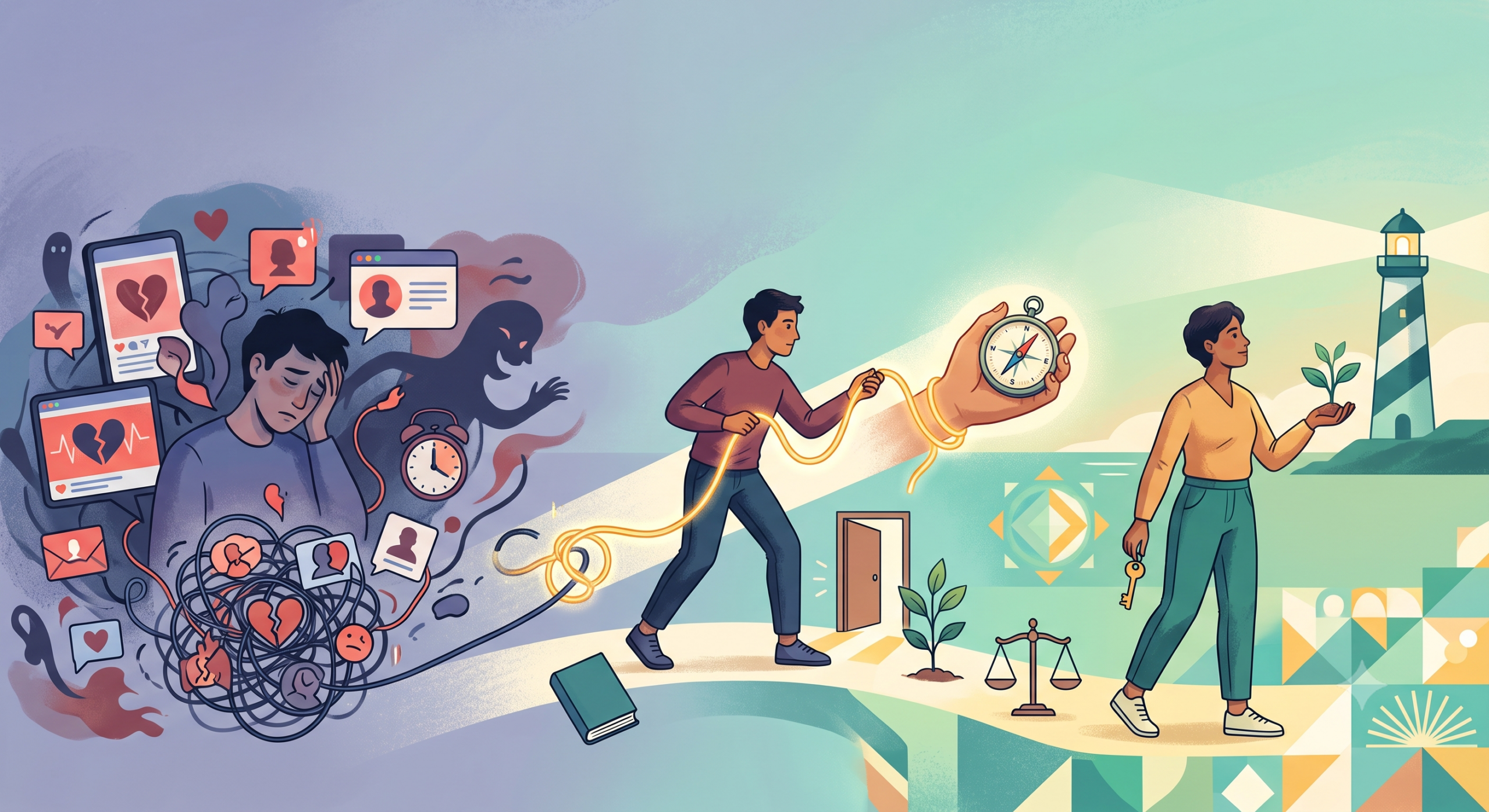
Hypersexuality. The word turns up everywhere lately — on social media, in the papers — usually with a little curl of judgement, or just to bait a click. But behind it there’s sometimes something far harder to live with. Sexual thoughts, fantasies and behaviours that take up so much room you can’t rein them in any more. And that, in the end, hurt.
Let’s clear one thing up straight away: hypersexuality isn’t “loving sex”. It isn’t having a high libido either. When psychologists and doctors talk about it, they mean something else entirely — loss of control, real distress, and consequences that keep coming back, in your relationship, at work, in everyday life.
This guide is here to answer the questions you might be turning over quietly:
- Is my relationship with sex simply intense, or is it starting to become a problem?
- Is it really a “sex addiction”, or the symptom of something deeper?
- And, most of all: what do I do if I recognise myself in this?
The Essentials in 4 Points
| Definition | Overwhelming, hard-to-regulate sexual behaviours that cause real distress |
| The Tell-Tale Sign | Loss of control, despite negative consequences that keep repeating |
| Clinical Status | Compulsive Sexual Behaviour Disorder (CSBD), recognised by the WHO in the ICD-11 |
| What Helps | Psychotherapy (CBT), treating any associated disorders, a bit of digital hygiene |
Hypersexuality: What Exactly Are We Talking About?
A Clinical Definition, Not a Judgement
Hypersexuality means frequent, overwhelming sexual thoughts, fantasies and behaviours that you can’t really regulate any more — and that spill over into the rest of your life: work, your relationship, your health, sometimes even your finances. It’s nothing to do with morality. Nothing to do with “liking sex too much”. It’s a difficulty with regulation, full stop.
Hypersexuality or Simply “High Sexual Desire”?
A high libido can be perfectly healthy. Fulfilling, even. An active sex life, frequent fantasies, plenty of curiosity — none of that is a problem in itself. We only start talking about hypersexuality when three things show up at once.
First, that feeling of no longer having a grip on your own behaviours. Then the attempts to cut down — which fail, again and again. And finally, carrying on anyway, when the damage is right there in plain sight: break-ups, risk-taking, sometimes debt.
Frequency on its own tells you nothing. A behaviour is never “abnormal” as long as it’s neither compulsive nor destructive. What makes the difference is the distress. And the loss of control.
Hypersexuality, “Sex Addiction” or a Behavioural Disorder?
What the ICD-11 (WHO) Says
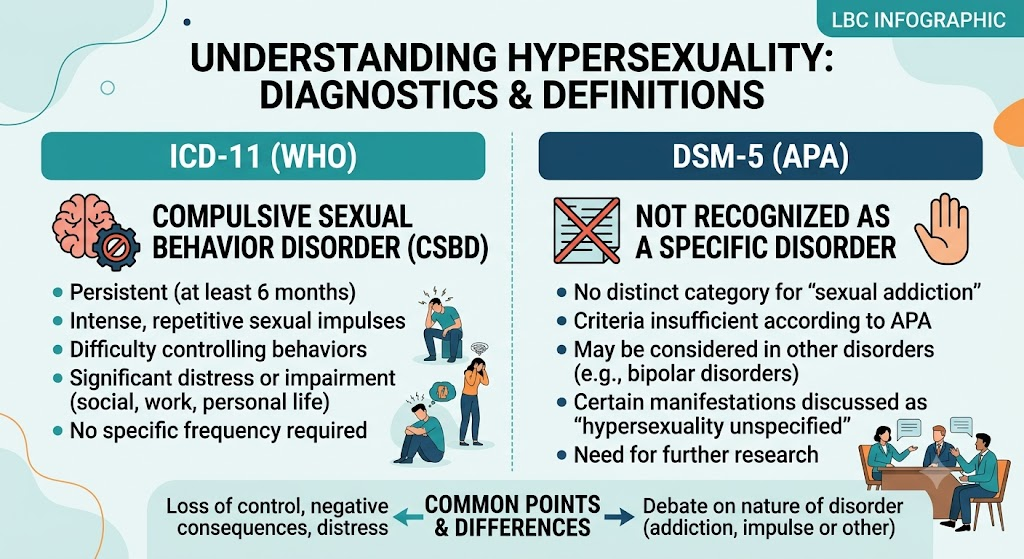
The World Health Organisation puts hypersexuality in a specific box: Compulsive Sexual Behaviour Disorder — CSBD for short. It’s an impulse-control disorder. In practice: repetitive, persistent sexual behaviours over at least six months, with genuine distress attached and a real impact on daily life.
What the DSM-5 (APA) Does Not (Yet) Say
On the American side, the DSM-5 — the other big reference classification — doesn’t yet recognise hypersexuality as a disorder in its own right. That difference tells you a lot about the debates running through the research. A standalone disorder? A symptom of something else? An extreme version of ordinary behaviour? The science hasn’t finished making up its mind.
Why This Distinction Matters for You
Ultimately, the label isn’t the point. What matters is that the suffering gets recognised, and that you can get support — psychological, medical, and sometimes sexological. Whether we call it “sex addiction”, CSBD or hypersexuality, the common thread doesn’t budge: a loss of control that causes suffering.
How Does Hypersexuality Show Up in Everyday Life?
The Psychological and Behavioural Signs
Some signals come up time and again. An almost constant preoccupation, with sexual thoughts or fantasies looping round. A need for more and more intensity — it always takes a bit more (content, practices) to feel the same relief. Turning to sex to switch off stress, loneliness or anxiety, a kind of emotional self-medication. And that sense of not being able to stop, even when you can see the risk coming a mile off.
When sex becomes a way of soothing difficult emotions, working alongside on how you actually meet those emotions often changes a great deal. → Read: Emotional Wellbeing: Handling Your Emotions Day to Day.
The Consequences for Personal and Working Life
Then there’s the fallout around it. Tension in the relationship, sometimes break-ups, secrecy, lies, occasionally a full-blown double life. Putting yourself at risk — for your health, through risky behaviour, even legal trouble. An impact at work: time that vanishes, concentration in pieces. And on top of all that, guilt, shame, self-esteem in free fall.
Often it’s the pile-up of these consequences — more than the behaviours themselves — that finally pushes someone to seek help.
Where Does Hypersexuality Come From? A Few Clues
There’s never one single cause. More like a cluster of factors that combine.
On the Psychological Side
Mood disorders (hypomanic episodes in bipolar disorder, in particular), anxiety, a history of trauma or sexual abuse, difficulty regulating your emotions. Very often, hypersexuality is the symptom of an older psychological pain sitting underneath.
On the Neurobiological Side
The reward circuit and dopamine play a central role in this search for stimulation. And for some people, hypersexuality can also be a side effect of medication — as happens, for instance, with the dopaminergic drugs prescribed for Parkinson’s disease.
On the Contextual Side
Ridiculously easy access to content online, the ability to hide everything, and social norms that can’t quite decide where they stand — swinging between hypersexualisation everywhere and stubborn taboo — can feed the disorder or make it worse.
Sexual Curiosity or Hypersexuality? 5 Questions to See Clearly
These questions don’t replace a diagnosis, mind. But they can help you spot a warning sign. Ask yourself honestly, without putting yourself on trial:
- Do my sexual behaviours cause me more suffering than pleasure?
- Have I already tried to cut down, without managing it?
- Have I ever put my health, my relationship or my work at risk because of this?
- Do I systematically lie about, or hide, what I do?
- Do I feel trapped in a cycle I can’t get out of?
If you answer “yes” to several of these, it’s no proof that you’re “abnormal”. Really, it isn’t. It’s simply a signal: your relationship with sex is causing you distress, and that deserves to be taken seriously. Gently. Not as a trial.
And if it’s been going on for months, talking to a professional is a good step. No urgency, no shame.
What Solutions and Treatments Are There?

The Psychotherapies
CBT — Cognitive Behavioural Therapy — is well suited to behavioural addictions and to CSBD. It works on thoughts, triggers, the little rituals, and the strategies for regulating all of it. Psychodynamic or integrative approaches, meanwhile, tend to explore trauma, your emotional history, the patterns that keep replaying in your relationships.
Medical and Sexological Support
Here you assess any associated psychiatric disorders, adjust medication when hypersexuality is linked to a treatment, and get psychiatrist, sexologist and therapist working together. Often, it’s by treating the cause underneath that everything else starts to shift.
Complementary Self-Help Strategies
None of this replaces proper support, but it can genuinely help alongside. A bit of digital hygiene, first: limit access, give yourself real breaks. Then routines that hold you up: move, sleep, find a support group. And little by little, relearn a more conscious sexuality — one that lines up with what actually matters to you.
Hypersexuality and Relational Anxieties: Threads That Cross
Hypersexuality as emotional self-medication sometimes overlaps with other forms of anxiety: fear of emptiness, emotional dependence, the fear of ending up alone. Understanding these neighbouring mechanisms stops you reducing the whole thing to sexual behaviour — when the real subject is often somewhere else.
Your Questions About Hypersexuality
Is hypersexuality a “sex addiction”?
The term gets around, but the WHO’s official classification (ICD-11) prefers Compulsive Sexual Behaviour Disorder (CSBD), filed under impulse-control disorders. The scientific debate is still open. The support available, though, is very real.
Can You Recover Without Treatment?
Some people manage to regulate their behaviour on their own. But when there’s a genuine loss of control and real distress, professional support markedly increases the chances of getting out for good — especially if an underlying disorder is in the mix. Asking for help isn’t an admission of weakness. It’s simply a strategy that works.
Is Every Strong Sexual Desire Pathological?
No, absolutely not. A high libido, an active sex life, plenty of curiosity — none of that is a disorder. We only talk about hypersexuality when there’s loss of control, distress, and repeated negative consequences.
How Do You Bring It Up With Your Partner?
Pick a calm moment. Talk about your suffering rather than trying to justify yourself. And present the step for what it is: a wish to get better. Couples support, alongside individual work, can sometimes help rebuild trust.
When Should You Seek Help, and Who From?
As soon as sexual behaviours cause lasting distress or repeated consequences. You can turn to a psychologist or psychotherapist (ideally trained in behavioural addictions), a sexologist, or a doctor/psychiatrist if an associated disorder or a medication is involved.
What to Take Away
If you’ve recognised yourself in this, it’s neither a moral failing nor a lack of willpower. Hypersexuality is a difficulty with regulation — often fed by an older pain. With the right support, you can take back the reins. And rediscover a sexuality that’s chosen, settled, genuinely true to you.
If the subject speaks to you and you want to move forward step by step, keep in mind that a mental health professional or a sexologist can support you without judgement — often it’s that first step that changes everything.
Sensitive Topic. This article is for information and does not replace medical advice. If you or someone close to you is struggling, a mental health professional or a sexologist can offer support.
Main Sources
WHO — ICD-11 (Compulsive Sexual Behaviour Disorder); Mayo Clinic; Cleveland Clinic; scientific journals (BJPsych Advances, PMC/NCBI). References to be added as nofollow outbound links when published.