

Maternal Instinct

The Myth, the Pressure, and How the Bond Really Develops
The maternal bond is not an innate superpower; it is an emotional connection built over time through experience, interactions, and life choices. Contrary to the persistent myth of the “automatic” maternal instinct, recent UK data from the Parent Infant Foundation (2025) reveals that 1 in 3 mothers do not feel an immediate “thunderbolt” of love at birth. This guide deconstructs the pressure of the “perfect mum” archetype, explains the science of attachment, and compares cultural approaches across Europe. Whether you are already melting at the sight of a newborn or feeling somewhat detached, you will find evidence-based answers here to understand—and soothe—your own maternal journey.
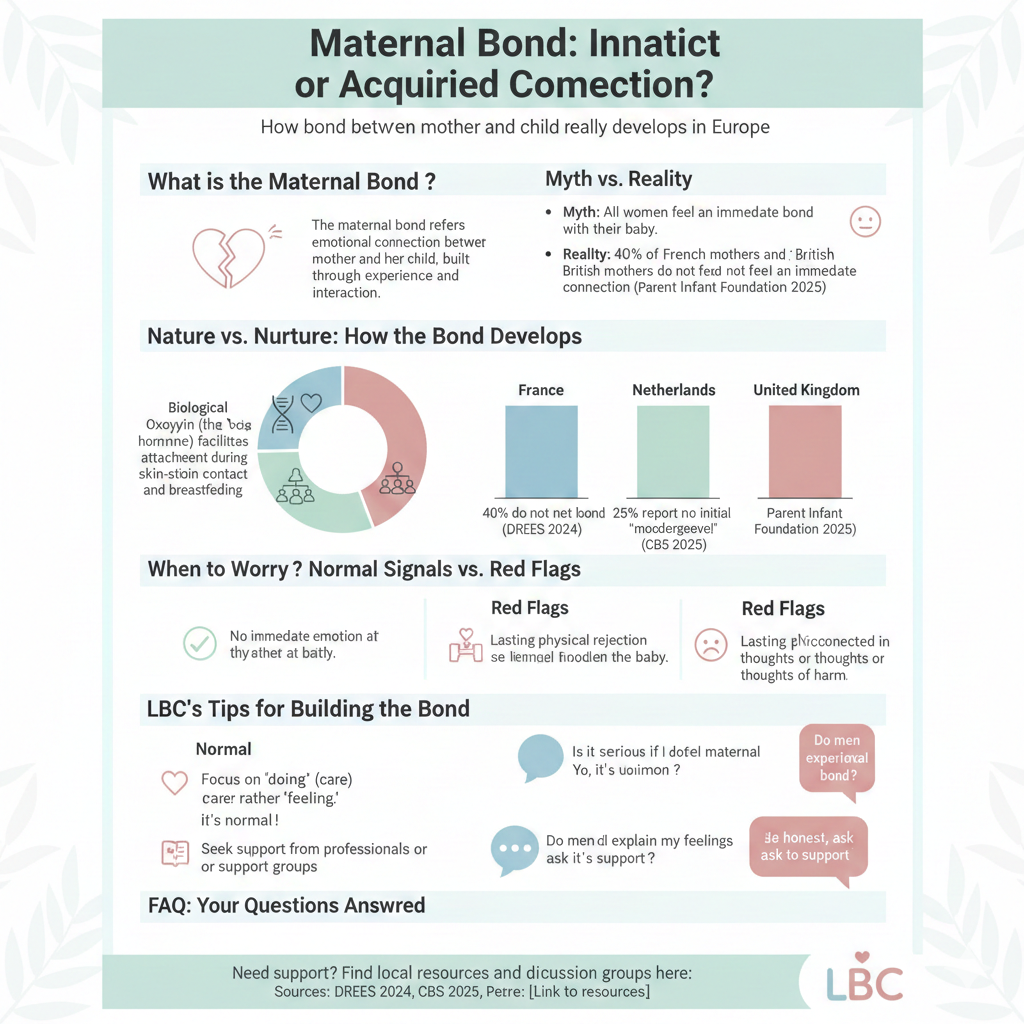
1. Maternal Bond: Definition, Myth, and the UK Reality
What exactly is the “maternal bond,” and why does the term cause so much anxiety for British women? Clarifying the vocabulary is the first step in breaking the “universal instinct” taboo.
Defining the Connection
The maternal bond refers to an emotional sensitivity towards children and a desire to care, but it is not necessarily a biological “switch” that flips during pregnancy. It is distinct from:
- Maternal Instinct: Often used to describe biological reflexes (e.g., waking up to a baby’s cry), though neuroscientists argue this “instinct” is actually a learned behaviour.
- Maternal Love: A constructed feeling that evolves through daily interactions and shared history.
The Weight of Social Norms
British society often perpetuates the “natural instinct” myth via High Street toy marketing (dolls and play kitchens), family expectations, and media portrayals of “instinctive” caregivers. In the UK, the Parent Infant Foundation notes that the “motherhood mystique” contributes significantly to postnatal anxiety, as women feel they are “failing” if the spark isn’t instant.
3 Myths to Deconstruct:
- “All women have a natural urge to be mothers” → False. The desire for motherhood is a personal and variable psychological choice.
- “Loving your baby is always immediate” → No. Attachment is a “slow-burn” process for many, taking weeks or months to solidify.
- “Not feeling maternal means you’re selfish” → Absolutely false. It is usually a result of temperament, exhaustion, or personal history.
LBC Advice: Observe your true desires without the filter of what the “perfect” mum on Instagram looks like. If this pressure causes significant distress, a conversation with your GP or Health Visitor can help navigate these feelings without judgement.
2. Nature vs. Nurture: A Scientific Blend

How is the maternal bond actually built? Research shows it results from several layers of experience that articulate uniquely for every woman. This is part of neuroplasticity—the brain’s ability to rewire itself during the transition to parenthood.
Biological and Biographical Components
On a biological level, oxytocin (the “bonding hormone”) facilitates attachment during skin-to-skin contact and breastfeeding. However, hormones are merely facilitators, not dictators. Your personal history is equally vital:
- Attachment Theory: British psychologist John Bowlby famously established that the way we were cared for as children influences our “internal working model” of parenting.
- Parental Models: Growing up with secure, emotionally available caregivers provides a blueprint for your own future bond.
Factors Influencing the Maternal Bond
| Key Factor | Effect on the Bond | Concrete Example |
| Secure Models | Fosters confidence in parenting | Having had an emotionally available caregiver. |
| Social Pressure | Produces guilt rather than desire | Hearing: “You aren’t a ‘real’ woman until you’re a mum.” |
| Support System | Strengthens maternal competence | A partner or “village” that allows the mother to rest. |
| Unresolved Trauma | Can hinder emotional projection | Fear of reproducing painful patterns from childhood. |
LBC Advice: Legitimise your ambivalence. Keeping a private journal or joining a support group can help you understand your emotions without self-criticism.
3. “I Don’t Feel Maternal”: The New UK Norm
Asking “why don’t I feel anything?” is one of the most common anxieties in UK maternity wards. Yet, statistics prove that the absence of a spontaneous “spark” is a statistical norm, not an anomaly.
The Reality in Figures (2024-2025)
- United Kingdom: 33% of mothers report feeling “disconnected” in the early days (Parent Infant Foundation, 2025).
- France: 40% of mothers do not feel an immediate “thunderbolt” of love (DREES, 2024).
- Netherlands: 25% of women report no initial “moedergevoel” (maternal feeling).
Normal Adjustment vs. Red Flags
It is crucial to distinguish between a normal “getting to know you” period and clinical conditions like Postnatal Depression (PND).
| Observed Sign | Normal (Give it time) | Red Flag (Consult a professional) |
| No emotion at birth | ✅ Common in the first month | ❌ Lasting physical rejection of the baby |
| Doubts about abilities | ✅ Standard “new mum” jitters | ❌ Recurring dark thoughts or thoughts of harm |
| Fatigue and irritability | ✅ Linked to lack of sleep | ❌ Total loss of pleasure, appetite, or insomnia |
LBC Advice: You are not alone. In the UK, NHS Health Visitors are specially trained to handle these conversations. Charities like PANDAS Foundation offer wonderful support for those struggling with the “disconnect.”
4. Pregnancy: When the Connection Starts (or Doesn’t)
Can the maternal bond begin before birth? For some, yes; for others, the “real” baby is required for the spark to ignite.
Prenatal Bonding Rituals
During pregnancy, the baby responds to voices and touch. This can nourish a sense of connection for some women through:
- Skin-to-bump contact: Noticing movements and “replying” with touch.
- Aural connection: Talking or singing to the baby (the baby can recognise sounds from 20 weeks).
- Visualising: Thinking about a name or preparing the nursery.
No Hard and Fast Rules
However, many women feel emotionally distant during pregnancy, focused instead on physical discomfort or career anxieties. This does not predict the quality of your bond post-birth. Many mothers report that the “love” only became real once they saw their child’s face.
LBC Advice: Pregnancy is not an “exam.” If you don’t feel a deep connection yet, it doesn’t mean you’ll be a “bad” mother. The real relationship often starts in the nursery, not the womb.
5. The Arrival: The “Good Enough Mother”
British paediatrician and psychoanalyst Donald Winnicott famously coined the term “The Good Enough Mother.” He argued that a mother doesn’t need to be perfect or instinctively magical; she simply needs to be present and responsive.
Bonding Through Care
Attachment is built through the repetition of daily tasks:
- Repetitive Care: Feeding, changing nappies, and rocking. These create physical familiarity.
- Fine-tuned Knowledge: Learning to distinguish a hunger cry from a “wind” cry. This skill reinforces your sense of competence.
According to recent studies (UniGE, 2024), mothers perform over 50 care interactions per day in the first three months. This mechanical repetition literally rewires the brain, increasing maternal confidence by 45% by week twelve.
LBC Advice: Focus on “doing” (the caregiving) rather than “feeling.” Love is often the byproduct of time spent and investment made.
6. Childfree by Choice: A Legitimate Decision
In the UK, the “Childfree by Choice” movement has gained significant visibility. It is entirely possible—and valid—to never feel a “maternal spark” and choose a life without children.
Autonomy and Respect
- Choice: 1 in 5 women in the UK reach age 45 without children, and for many, this is a conscious, happy decision.
- Alternative Connections: Many “childfree” women express their maternal energy elsewhere—as devoted aunts, godmothers, or through professions in education and healthcare.
Protecting Your Boundaries
3 phrases to handle family pressure:
- “My happiness and fulfilment are not dependent on motherhood.”
- “I am deciding what is best for my body and my future.”
- “I respect your choice to have children; please respect my choice not to.”
FAQ: Maternal Bond
Is it bad if I don’t feel “maternal” before getting pregnant?
Not at all. Many women have zero interest in other people’s children but become fiercely bonded to their own. Your bond with your child is unique.
Do men have a “parental bond”?
Yes. Studies show that involved fathers experience a rise in oxytocin and brain changes similar to mothers. Caregiving is a skill, not a gendered trait.
What are the UK resources for bonding issues?
- NHS: Speak to your GP or Health Visitor.
- PANDAS Foundation: Support for PND and birth trauma.
- Mind: Excellent resources on maternal mental health.