

Children’s Spiritual Protection: A Guide for Modern Moms

Protecting Without Smothering
Is your maternal instinct sounding the alarm over the challenges of the modern world? Are you looking to build a protective cocoon around your child without smothering them? Between spirituality and gentle care, discover how to become the enlightened guardian of your little treasure’s soul.
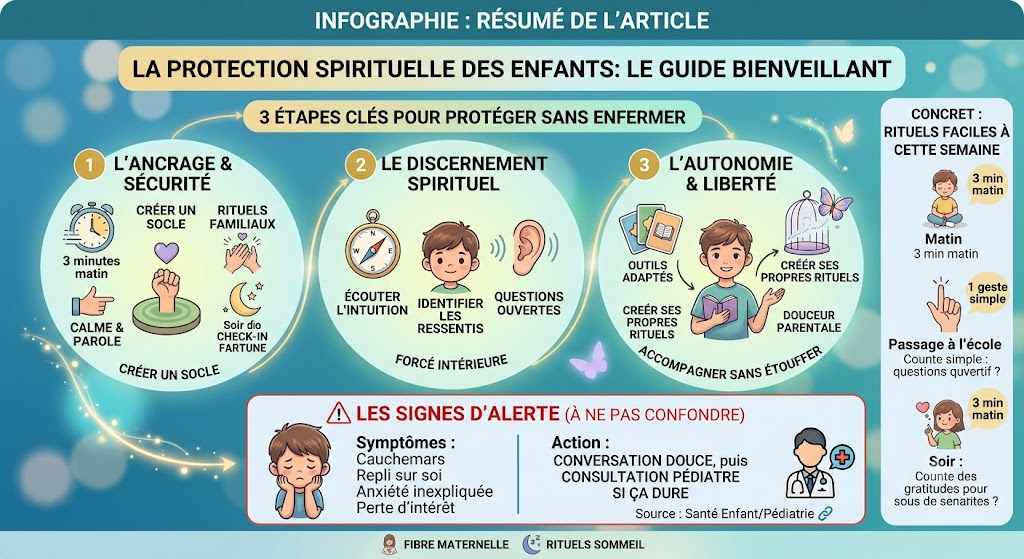
There’s that moment, in the evening, when you watch him sleep and a little knot forms somewhere between your stomach and your throat. He’s there, tiny, trusting. And you’re thinking about screens, the playground, the stories you hear about what goes on in the classroom next door. You’d love to wrap a bubble around him and seal it shut.
Every mother knows this feeling. It’s actually a good sign: it means your radar is working.
The question isn’t whether you’re right to want to protect him. The question is how to do it without turning the bubble into a cage. Because an overprotected child doesn’t become a stronger child — he becomes a child who never learned to stand on his own. And that’s exactly where spiritual protection finds its meaning.
What “spiritual protection” really means
The art of everyday protective rituals

In our fast-paced modern world, creating sacred moments has become essential to protecting our children’s spiritual balance.
Let’s say it upfront: this isn’t about magic, formulas, or anything that requires believing in a particular way.
A child’s spiritual protection is far more down-to-earth than that. It’s the set of reference points you place around him so he feels safe, knows where he lives inside himself, and can return to that anchor point when the outside world gets loud.
A child who has that copes better. A hurtful comment at school doesn’t crush him for three weeks. Changing schools doesn’t uproot him. He has a foundation.
That foundation is built in two ways, and both matter equally. There’s calm — moments in the day when nothing demands anything of him, when he can simply be. And there’s words — regular chances to say what he’s feeling, even when it’s muddled, even when it doesn’t come out right.
Everything else is just form. Prayer, meditation, gratitude, shared silence: each family picks whichever fits them. The substance doesn’t change.
To try this week: spot a moment in your day that’s already calm — the car ride, bath time, the five minutes before lights out. You’re not creating a new one. You’re taking the one that already exists and you stop filling it with noise.
The signs you shouldn’t confuse
Here we need to be precise, because this is exactly where a lot of articles on this topic go wrong.
Some things in your child look like a need for calm and grounding: he asks questions about death, about where people come from, about what happens afterward. He’s particularly sensitive to atmosphere, he senses when things are off between the adults in a room. He needs more alone time than other kids. These are traits, not symptoms. They call for listening, not intervention.
But other signs don’t belong to that category at all. Nightmares that come back night after night. A child who withdraws when he never used to. Anxiety that nothing explains. Losing interest in what he used to love most.
Those four aren’t spiritual signals. They’re signs that something is wrong — and the list of what might be behind them is long: bullying at school, a family change he hasn’t processed, an anxiety disorder, sometimes something else entirely.
What you need to do is simple. First, open the conversation — no interrogation — by sitting beside him rather than facing him — often in the car or during an activity, that’s when children talk most freely. And if it goes on for more than two or three weeks, talking to his doctor or checking the resources from the French Society of Pediatrics can help rule out any medical cause.
No evening ritual replaces that. A spiritual framework accompanies a child; it doesn’t treat what needs treating. An honest big sister will tell you straight: the candle is lovely, but not instead of the doctor’s appointment.
Three rituals that fit into a normal day
Building inner strength

Guiding our children’s spiritual life is a bit like the delicate art of gardening: we create the best conditions for their growth while leaving them free to bloom at their own pace.
Now, the practical part. And practical, here at LBC, means things that actually fit into a real day, with a real alarm clock that goes off too early.
Morning: three minutes, no more
Before the phone enters the room, before the missing shoes, sit for a minute on the edge of his bed. You breathe. You each name one thing you’re looking forward to today — even something tiny, even “recess.”
Three minutes. It sounds trivial. Yet it’s exactly what your child carries with him as he walks through the school gate.
Drop-off at school: one gesture, always the same
Children love gestures that never change. A hand on the forehead, a word whispered in the ear, a secret sign made up just for the two of you — it doesn’t matter which one, as long as it’s the same every day.
That gesture becomes a physical anchor. It says: you’re leaving, but you’re taking something of me with you.
Evening: closing the day
Coming home deserves its own little ritual too. Some kids need to shake out their hands and feet to “shake off” the day, others need to run around for ten minutes, others need to not talk to anyone for a quarter of an hour. Watch yours — he’ll show you.
And at bedtime, the question that works better than any other: “What was good today?” Then, only after: “And what wasn’t so good?” The order matters. He drifts off with the positive sitting last in his mind.
To try this week: pick just one of these three moments. Not all three. The one your day can actually absorb, and stick with it for seven days straight. A ritual that lasts is one you never had to abandon after three days.
Praying, meditating, or just talking
If prayer is part of your life, it has every place here. One piece of advice, though: memorized formulas quickly lose their meaning for a child. What really grounds him is putting his own words on what worries him and what he hopes for.
If you’re more comfortable with meditation or breathing exercises, it works exactly the same way. Three slow breaths, focusing on the air going in and out, is already all a six-year-old needs.
And if none of that sounds like you, you still have the best tool of all: conversation. A child who knows he can tell someone anything without being judged has the sturdiest protection there is.
One tool that works well no matter your style: a notebook where he draws what he can’t put into words. Many children say in drawing what they’ll never say out loud.
Protecting without smothering: where to draw the line
This is the hard part, and I’m not going to pretend it’s simple.
Your role changes over the years. At first, you set the frame: you decide the rituals, you keep the rhythm. Then, gradually, you hand it over. Around seven or eight, he can choose his own way of closing his day. In his teens, he’ll invent his own, often very different from yours — and that’s the sign it worked, not the opposite.
Three habits help you hold that line.
Ask questions rather than give answers: “What do you think?” opens up far more than a ready-made explanation.
Welcome doubt. The day he says he doesn’t believe it, or doesn’t want to do the evening ritual anymore, don’t take it as a failure. A child who questions is a child who thinks.
And stay available without being everywhere. He needs to know he can come back to you — not feel you constantly looking over his shoulder.
To try this week: next time he asks you a big question, resist the urge to answer right away. Bounce it back: “What do you imagine?” You’ll be surprised.
What I’d keep, just between us
The protection you’re trying to give him, he won’t find in an object, or in a formula. He’ll find it in the consistency of what you put around him, and in the certainty that he can talk to you.
A protected child isn’t a child sheltered from everything. It’s a child who has somewhere to return to when things get shaky. And you can build that with three minutes in the morning and one question at night.
The rest will settle into place on its own.
If you want to dig deeper into what’s really at play in that bond — why some mothers feel it instantly and others don’t feel it at all, and why both are perfectly normal — go read our article on maternal instinct, innate or acquired. It pairs nicely with this one.