
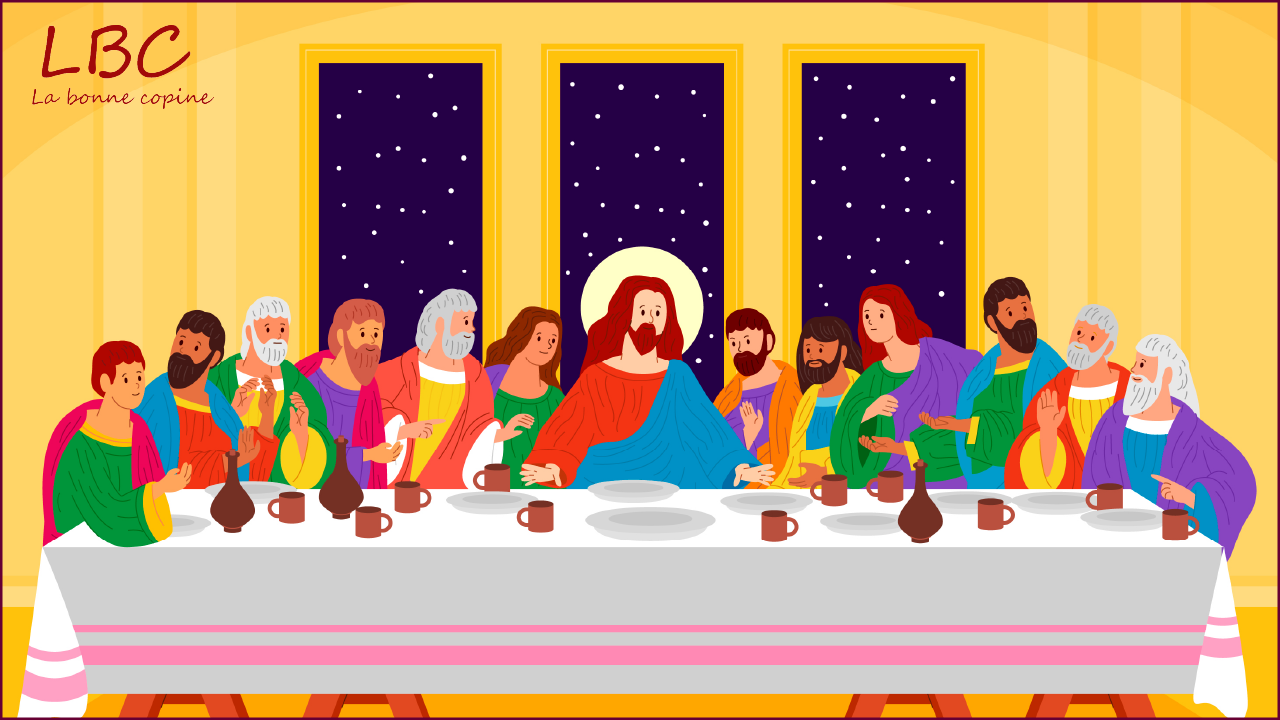
A Modern Parody of the Last Supper by Charles Declercq

What if the Last Supper parodied today?
Charles Declercq’s provocative Parody of the Last Supper reimagines the sacred meal with modern symbols, challenging viewers to reconsider love, sacrifice, and the true message of Christ in today’s world.
“All art is a form of rebellion against the limits of tradition.”
Albert Einstein
And what if the Last Supper, one of Christianity’s most sacred moments, were revisited through a modern lens? Charles Declercq shakes up the traditional image of Christ’s final meal in a daring, meaningful parody. A critical look at love, sacrifice, and Christian values, this work invites reflection while defying conventions. Far from being mere provocation, it breathes new life into tradition, reinterpreting it with brilliance. Ready to see the Last Supper from a completely new angle?
The Last Supper, Jesus’ final meal with his disciples, holds a central place in Christian tradition. This deeply symbolic scene has been revisited and reinterpreted by countless artists over the centuries. Among these reinterpretations, the one by Charles Declercq stands out for its bold parody, inviting reflection on love, sacrifice, and the true essence of Christ’s message. In this article, we will explore this parody work, analyzing how it revisits profound theological and social concepts while offering a subtle critique of contemporary practices. We will see how Declercq, through this parody, questions religious traditions while emphasizing the universality of love’s message.
Uncovering the Origins and Artistic Evolution of the Last Supper
Biblical Origins
The Last Supper originates in the Gospels, depicting Jesus’ final meal with his disciples before his crucifixion. This moment forms a divine covenant, a symbolic gesture that foreshadows the coming suffering and sacrifice. In Christian tradition, the Last Supper marks the beginning of the Eucharist, celebrated as a sacred act of communion. This meal also announces Judas’ betrayal and underscores the necessity of Christ’s redemptive sacrifice for humanity.
Traditional Representations
Over the centuries, the Last Supper has inspired numerous artworks, the most famous likely being Leonardo da Vinci’s late‑15th‑century masterpiece. This fresco, now globally recognized, helped cement the image of the Last Supper in the collective imagination. Other classic works have enriched this vision, each offering a unique interpretation shaped by its era and artistic style. These depictions have always aimed to capture the spiritual and emotional intensity of the moment while highlighting the communion between Jesus and his disciples.
Evolution of Interpretations
Over time, modern and contemporary artists have reimagined this iconic scene in line with the social and religious issues of their day. The traditional image of the Last Supper has often been revisited—sometimes critically—to spotlight contemporary concerns. This evolution has allowed many works to raise questions about the nature of faith, love, and human relationships in an ever‑changing world.
Declercq’s Daring Parody of the Last Supper
Introducing the Work
Charles Declercq, an artist and priest, created a parody of the Last Supper that deconstructs the scene’s traditional elements to offer a fresh reading. His work does more than copy the classic composition; it inserts a social and religious critique through unexpected, sometimes unsettling visual elements. By re‑appropriating this sacred moment, Declercq questions the role of the sacred in modern society and explores how Christ’s message can still resonate in a world often detached from its original values.
Decoding the Symbols
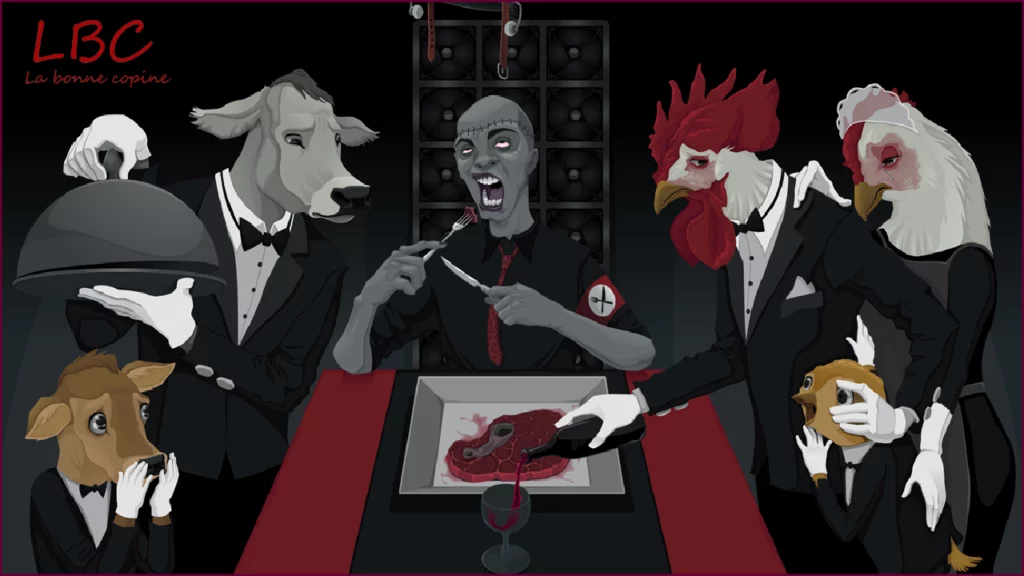
In this parody, Declercq retains certain essentials of the traditional scene—the table, the figures, and the idea of communion—but twists them to insert contemporary symbols. For instance, the characters are not merely the apostles and Jesus; they embody modern stereotypes such as figures of authority, pop‑culture icons, or representations of mass consumption. These elements symbolize the distortion of Christian love in an age where spirituality often drowns in materialism and individualism. Much like how humor challenges authority, Declercq uses parody to question established power structures.
Artistic Techniques
Declercq employs modern artistic techniques to create a critical distance from the traditional depiction of the Last Supper. He manipulates composition, figure scale, and color contrast to subvert the viewer’s visual expectations. These choices aim not merely to shock but to invite deeper reflection on the Last Supper’s meaning in a postmodern context. By deconstructing the sacred image, he reaffirms its essential truths while challenging the religious and social status quo.
Exploring Love and the Heart of Christ’s Teaching
Love as the Central Theme
Beyond its iconographic aspects, Declercq’s parody chiefly questions the notion of love in the Christian message. In the Gospels, Christ preaches a radical, unconditional, sacrificial love—one that unfolds in the act of giving one’s life for others. Through his parody, Declercq examines the idea of love diverted, often seen in modern society as a commodity or a manipulation. His work urges us to reconsider how love is practiced today, especially in a world where solidarity and sacrifice can be overshadowed by economic or political logic. This connects deeply with the philosophy of family love across different eras.
Social and Religious Critique
Declercq’s parody of the Last Supper goes far beyond a simple artistic reinterpretation. It raises a sharp social and religious critique, questioning contemporary practices within religious institutions and how those institutions have evolved over time. Rather than merely mocking or denouncing, Declercq seeks to awaken collective awareness of the growing disconnect between original Christian values and their modern interpretations. By placing the scene in a contemporary context, he urges viewers to reflect on the true meaning of sacrifice and community. Learning how to assert your values with conviction becomes essential in this context.
A Universal Message
Despite its critique of religious and social structures, Declercq’s work transcends Christianity to address universal themes. Love, solidarity, and sacrifice are not concepts reserved for believers; they are principles that can resonate in every facet of human life. By parodying the Last Supper, Declercq invites everyone to reconsider these core values and apply them more authentically, free from external pressures.
How the Parody Was Received and Its Impact
Public and Critical Reactions
Charles Declercq’s parody of the Last Supper has provoked a range of reactions. Some viewers were deeply shocked by the subversion of this sacred scene, seeing it as an affront to religious tradition. Others, meanwhile, praised the artist’s courage, appreciating how he confronted religious and social institutions with their contradictions. Critics often highlighted the work’s boldness, noting it manages to balance social critique with respect for the Christian message.
Influence on Contemporary Art
The impact of this work extends beyond religious art, influencing several contemporary artists. By reinterpreting such a powerful symbol as the Last Supper, Declercq has opened the door to a broader reflection on how the sacred is portrayed in modern art. The piece has thus contributed to a reevaluation of how sacred art is perceived and renewed in a world where spiritual reference points are increasingly blurred.
Conclusion
The parody of the Last Supper by Charles Declercq is a deeply provocative and thoughtful work that goes far beyond a simple critique of religious tradition. It opens a space for dialogue about the true essence of Christ’s message, centered on love, sacrifice, and community. By subverting such an iconic scene, Declercq urges us to reexamine our social and religious practices while offering a universal message that resonates well beyond Christianity’s borders.
Invitation to Reflect: Declercq’s parody of the Last Supper invites viewers to consider how love and sacrifice are understood in our modern world. A call to rethink essential values and apply them more sincerely and authentically in our daily lives.