
Master the Past Participle Agreement in French: 6 Essential Rules

Feel stuck every time a French exercise asks you to match a verb’s ending? You’re not alone—cracking the past participle agreement is the discover the power of laughter that turns hesitant speakers into fluent ones. In this guide we break down the six rules you need, plus the two sneaky traps even native speakers miss.
Quick Reference: The Agreement Dashboard
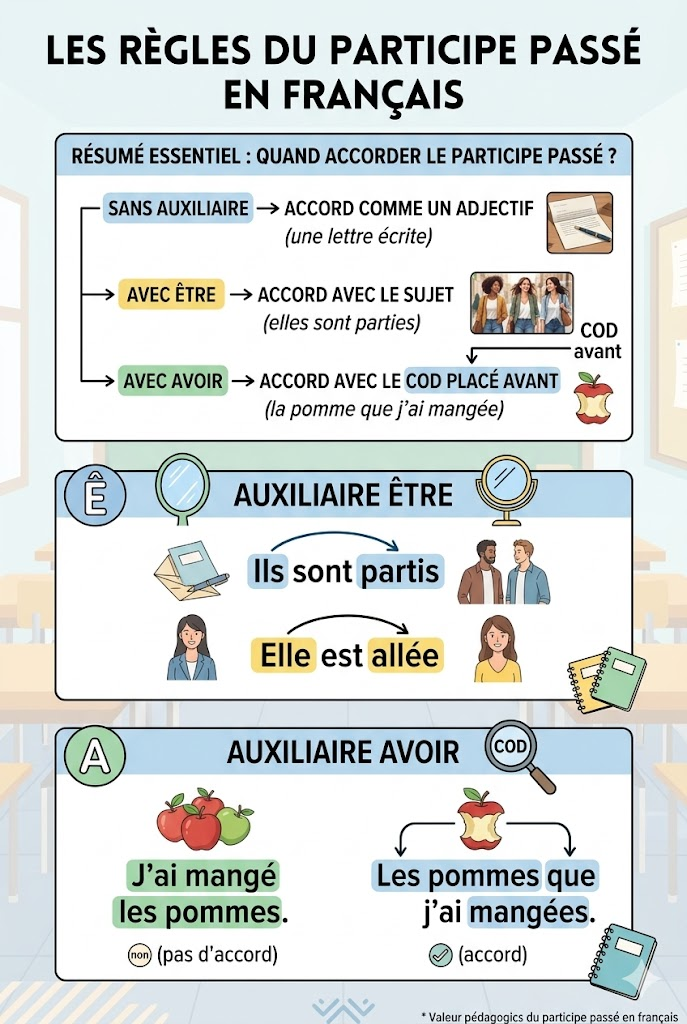
| Situation | Auxiliary | Rule | Example |
| No auxiliary | — | Treat as adjective | a written letter |
| With ÊTRE | être | Agree with the subject | They left |
| With AVOIR | avoir | Agree with the direct object that precedes the verb | the apple that I ate |
If you remember one thing: with avoir you never look at the subject—you hunt the direct object.
How to Spot the Right Past Participle Ending
The first source of stress, but once you know the pattern it’s a breeze.
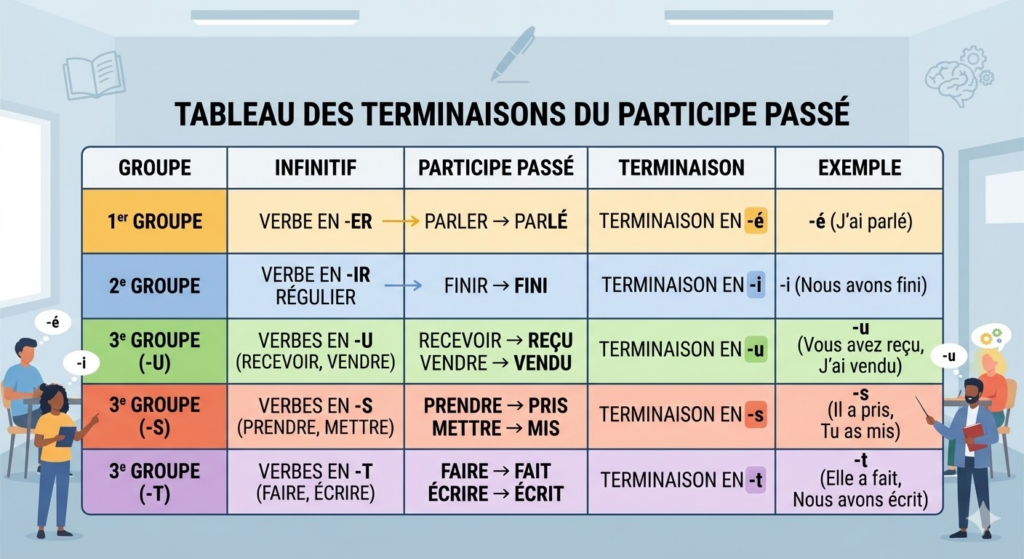
-ER verbs (1st group): always end in -é. mangé, parlé, aimé. No exceptions.
-IR verbs (2nd group): always end in -i. fini, choisi, réfléchi. Simple.
3rd group – the “chaos” zone: Here logic seems to collapse. pris, fait, mis, écrit… Pro tip: put the participle in the feminine form to hear the silent final consonant. pris → prise (adds ), fait → faite (adds
The Mirror Rule: Agreement with ÊTRE
When être is the auxiliary, the past participle mirrors the subject—gender and number follow suit.
She went allée to the station. (feminine singular) They left partis early. (masculine plural)
Two families belong here: movement verbs (the classic “House of Être”: aller, venir, partir, arriver, naître, mourir and their compounds) and the passive voice (Les décisions ont été prises).
Remember, pronominal verbs also use être, but their agreement follows special rules discussed later. ← → [Our article on French pronominal verbs]
[Image 3: alt=”diagram of the House of Être showing movement verbs”]
The Avoir Mystery: Finding the Direct Object
This is where 80 % of errors hide. The rule is crystal clear: ignore the subject entirely. Hunt for the direct object (the answer to what? or whom?).
- Direct object after the verb → no agreement. I ate the apples.
- Direct object before the verb → agreement required. The apples that I ate.
The same logic applies to personal direct‑object pronouns: I saw them leave. (them precedes the verb, so the past participle agrees in masculine plural). ← → [Practice exercises on avoir agreement]
Field Notes: What I See When Grading French Learners
During 2026 correction sessions, the most stubborn mistake wasn’t what we expected. Learners master the être rule quickly; the real snag is the pronoun en.
Many students, having grasped the “preceding direct object” rule, write naturally: “Des fleurs, j’en ai cueillies.” It sounds logical—en acts like a direct object before the verb. Yet, according to Le Robert, the past participle stays invariable with en. One of the rare cases where intuition betrays even the best students.
Rule confirmed 15/03/2026.
[Image 4: alt=”list of past participle agreement exceptions”]
FAQ: Your Burning Questions About Past Participle Agreement
Does the past participle agree before an infinitive? Yes—only when the preceding direct object actually performs the infinitive’s action. “The musicians that I heard play” → agreement, because the musicians are the ones playing. “The song that I heard sing” → no agreement, because the song isn’t singing itself. TV5 Monde explains that this nuance is a C1‑level criterion.
Why “Elles se sont lavé les mains” without agreement? Because les mains is the direct object and it appears after the verb. The reflexive pronoun se functions as an indirect object here, so no agreement—a classic exam pitfall.
Do pronominal verbs always agree? No. Reflexive and reciprocal forms follow the same direct‑object rule as with avoir. Passive‑sense pronominals (Elle s’est blessée) generally agree with the subject. Identifying the pronoun’s function is the key.
✍️ About the Author
Marie Dupont is a passionate French teacher who loves her students and her craft. She champions culture, reading, and artistic experiences while savoring simple, personal moments every day.
- Professional background: Teaching since 1986; worked in the North (Douai) and Niort.
- Education: Five‑year literature degree, Master’s in Modern Letters, CAPES success.
- Teaching passion: Engages wholeheartedly with her classes.
- Roots & life: Born in the Landes, cat enthusiast.
- Hobbies: Reading, walking, travel, meeting friends.
- Childhood memory: Loved The Wonderful Adventures of Nils Holgersson by Selma Lagerlöf; adored Swan Lake and The Jungle Book.
- Daily joys: Love, family, students, a good book, and the beauty of everyday life.
Mastering the past participle agreement transforms your French from shaky to sleek. Keep these six rules close, practice with real sentences, and watch your confidence soar.