
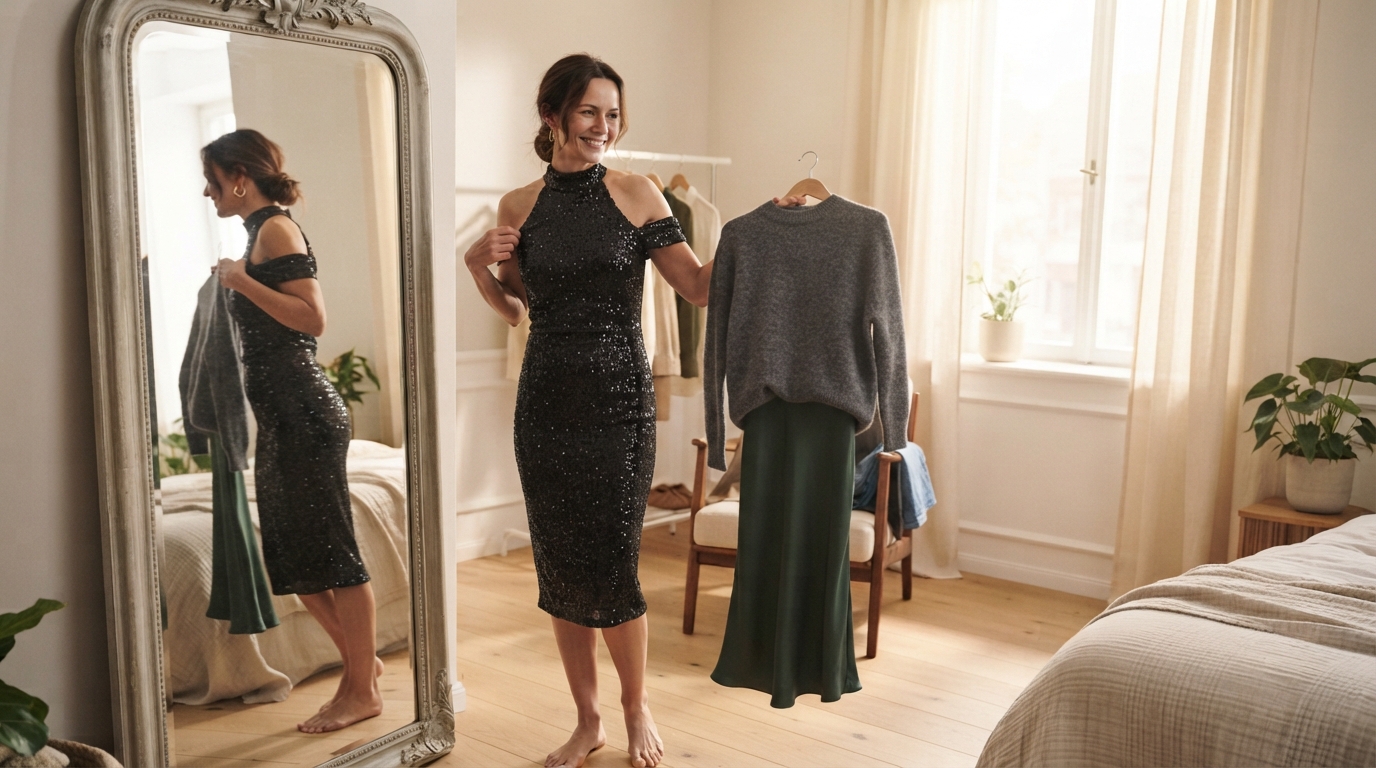
What to wear on a first date when you want to stay true to yourself

What to wear on a first date: the question has been going round and round in your head ever since you put the time in your phone. You’re standing in front of your wardrobe, already wearing the third outfit of the evening, wondering whether this top will stay in place without you having to pull it up every five minutes, whether this skirt will let you walk normally, and whether the other dress might actually have been better. Breathe. Let’s take this calmly.
This kind of panic has a simple name: dressing for someone else’s gaze rather than for yourself. And the opposite is what works. A successful first-date outfit isn’t the one that ticks every box on a perfectly curated Pinterest board. It’s the one you forget you’re wearing after twenty minutes, simply because it asks nothing of you.
This guide isn’t going to tell you which colour to wear or which cut suits you “best”. It will help you ask the right questions before opening your wardrobe: where you’re going, what the weather will be like, and how you’ll be moving that evening. The rest, you already know, often better than any article could tell you.
What to wear on a first date : the real question isn’t how to impress
That’s the starting point, and it changes everything. Asking yourself “what will they like?” puts the evening in someone else’s hands before it has even begun. An outfit chosen for you, on the other hand, leaves your mind free for the conversation, rather than constantly monitoring your neckline.
That’s why the central rule is worth its weight in gold: if you catch yourself rearranging your outfit more than twice before leaving, pulling down the hem, raising the collar, checking that nothing is gaping, change it. Not because the outfit is bad. Because spending an evening monitoring a piece of clothing is an evening when, mentally, you’re never completely present. The person opposite you is talking, while part of your mind is still calculating the angle at which you’re sitting.
In other words, the real test doesn’t happen in front of the mirror. It happens when you’re moving, sitting down and raising your arms to pick up your bag. If the clothes move with you without asking for your attention, they’re right.
The hands-free mirror test : Put on the outfit, place your hands behind your back and stay like that for one minute, talking out loud as if you were telling someone about your day. If you’ve wanted to touch a crease, collar or hem more than twice, it’s not the right outfit for tonight.
What the science of clothing and confidence really says
This isn’t just big-sister intuition. Social psychology researchers have been studying for more than a decade what is known as “enclothed cognition” , the idea that what we wear can actually influence the way we think and behave, not just the image we project.
A meta-analysis examined more than a hundred measured effects, involving nearly 3,800 participants in total. It concluded that the more recent and better-designed studies on the subject point in the same direction: the clothes we wear do have a measurable effect on cognition, emotions and behaviour, not just on the image we project.
For a date, this means something very simple. Comfort isn’t a secondary detail. It’s what determines whether you spend the evening inside your head, available to listen and respond, or inside your body, busy dealing with clothes that make you uncomfortable. Comfortable clothing doesn’t make you less elegant. It makes you present.
Think about the last time you wore something that irritated you throughout an entire evening. You probably remember the discomfort better than the conversation itself. That’s exactly the mechanism we want to avoid before a first date, when every minute of attention matters twice as much.
Seven seconds, 55/38/7 : the figures we repeat without checking them
You’ve probably come across these statistics before: supposedly, a first impression is formed in seven seconds and is based 55% on appearance, 38% on tone of voice and only 7% on words. Except that these two figures, as they’re repeated everywhere, are misquoted.
The actual study behind the idea of “instant judgment” was conducted by Janine Willis and Alexander Todorov, researchers at Princeton. It showed that the brain forms a first impression of a face in just one tenth of a second, not seven seconds. Increasing the observation time barely changes the initial judgment; it simply increases confidence in that judgment, which is very different.
As for the famous 55/38/7 rule, it comes from experiments conducted by Albert Mehrabian in the late 1960s, using a very small sample and dealing only with the perception of a feeling expressed ambiguously, not communication in general, let alone appearance. Mehrabian himself tried to correct this interpretation, without success. The formula became a self-development dogma, largely detached from what it actually measured in the first place.
So, what should you wear on a first date once we’ve thrown those figures out the window? The real answer isn’t found in a percentage or a stopwatch. It’s found in the setting.
Let the setting decide what to wear on a first date, before anything else
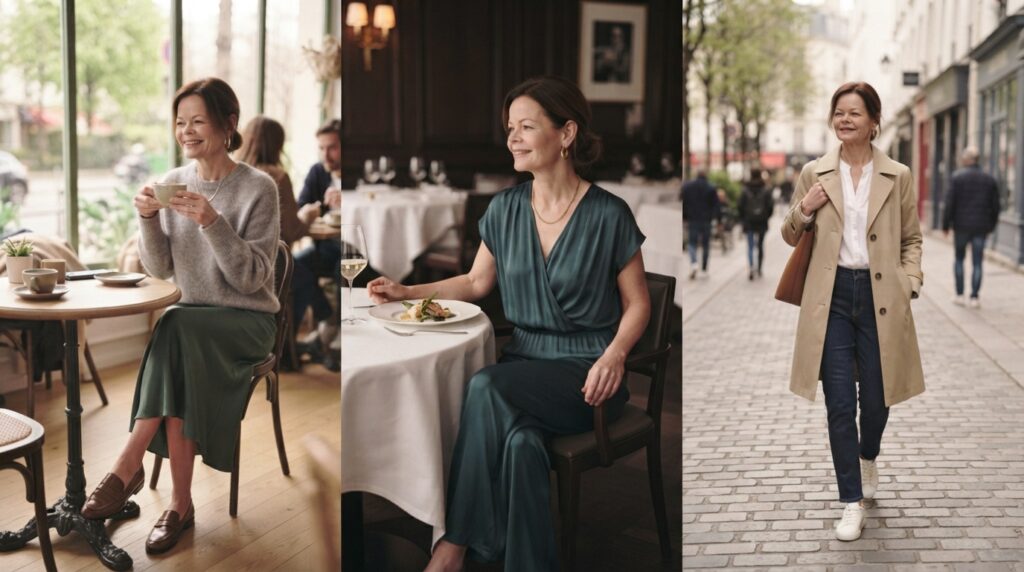
Before the colour, before the cut, and even before the idea you have of yourself that evening, there’s a much more useful question: where are you meeting? No two dates are exactly alike. And the perfect outfit for one can become a real ordeal for another.
A coffee or a drink
You’ll be sitting, usually on a not particularly generous chair, for an hour or two. A structured outfit with seams that dig into your stomach can quickly become uncomfortable. It’s better to choose a fabric that moves with you, without making you think about your posture.
A dinner
You’ll sit down, eat, perhaps have another serving, and talk with your mouth full without even thinking about it. Avoid anything that feels tight around the waist. A piece that relaxes slightly as the meal goes on is a real gift to yourself.
A walk or stroll
Here, your whole body is involved. The fabric needs to allow for long strides. Your shoes, meanwhile, should already have proven themselves we’ll come back to that in a moment.
An exhibition, cinema or activity
You’ll be standing, moving around, sometimes in the dark or in the chill of an air-conditioned room. An extra layer you can remove or keep on often matters more than a fixed, flawless look.
The setting checklist : Before choosing your outfit, imagine three concrete actions you’ll make during the date: sitting down, walking and taking off your coat. Picture yourself doing them in the outfit. If even one of these actions makes you uncomfortable just thinking about it, change something.
Weather and season : dressing for the actual evening

In France, an August date is nothing like a November date, and yet many fashion tips completely ignore this factor. A pleasant terrace in the late afternoon can quickly become chilly after 9 pm. A restaurant, meanwhile, can be overheated in the middle of winter. That’s why a transitional layer, a thin cardigan, lightweight jacket or shawl is often better than an all-or-nothing choice.
And then there’s the rain, the quintessential French wildcard, showing up without warning even in the middle of June. Planning an outer layer that can stay with you at the table without ruining the outfit means avoiding arriving windswept and soaked. Or, on the other hand, dragging a puffer jacket around all evening because you overprepared.
A comfortable body, not a silhouette to correct
There is no body shape to correct before a date, only a body to listen to. The right question is never “what will hide what?” but rather “what will let me sit, laugh and breathe without thinking about it?” A fabric that scratches, a neckline that requires constant checking, trousers that dig in every time you sit down : these are details that take up far more space in your mind than any question of cut or size.
Every body shape deserves the same thing : an outfit that lets the body relax. Not a list of pieces to wear or avoid depending on your figure. You can leave that logic at the door, permanently.
If you’re walking, test your shoes first
Beautiful new shoes, carefully saved for the occasion, are the number one trap. A pair you’ve never worn can rub, slip or feel unstable within the first few hundred metres. The right move is to wear them at home for a good hour during the week before, actually walking in them, not just crossing the living room twice.
The fifteen-minute home test : On the day of the date, put on the complete outfit, including your shoes, fifteen minutes before leaving. Sit down, stand up, walk to the door and come back. What you feel at that exact moment is exactly what you’ll feel throughout the evening.
What to wear on a first date : the rule that sums it all up
In the end, what to wear on a first date comes down to one honest question : does this outfit leave you alone? Not perfect, not spectacular, just peaceful. The kind of outfit that lets you laugh loudly if you feel like it, sit cross-legged if the bench allows it, or run through the rain to the bus shelter without thinking about your mascara running or your skirt riding up.
And if, as you leave home, you catch yourself adjusting a strap or collar for the third time, you already know what to do. Go back and change. Being five minutes late is always better than spending an entire evening somewhere other than in the conversation.