5 Signs of Anuptaphobia: Understanding and Overcoming the Fear of Being Alone

“Terrified of Being Single Forever? You Might Have Anuptaphobia (And Not Know It)“
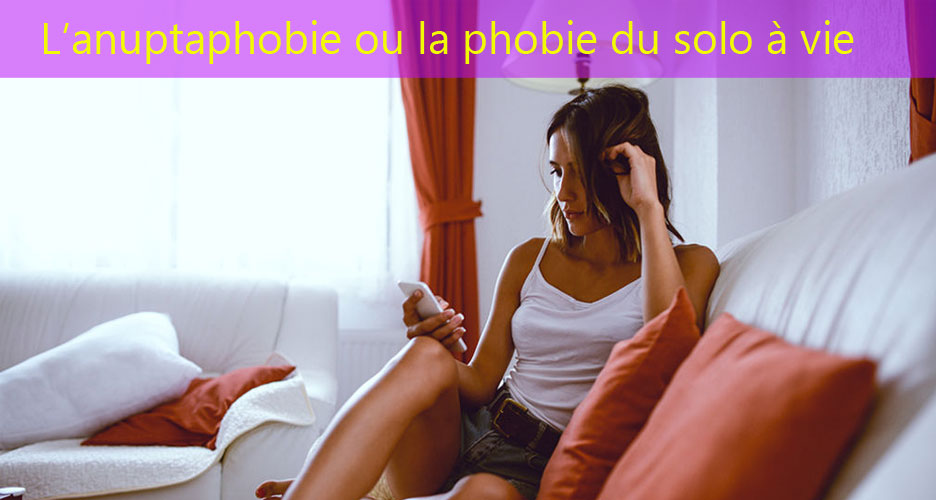
Anuptaphobia isn’t simply a preference for being in a relationship — it’s an irrational, paralysing fear of spending your life alone, one that can drive people to stay in clearly toxic relationships rather than face the void. According to PasseportSanté (March 2026), this affective phobia is among the most under-diagnosed anxiety disorders, largely because it hides behind social pressure and shame.
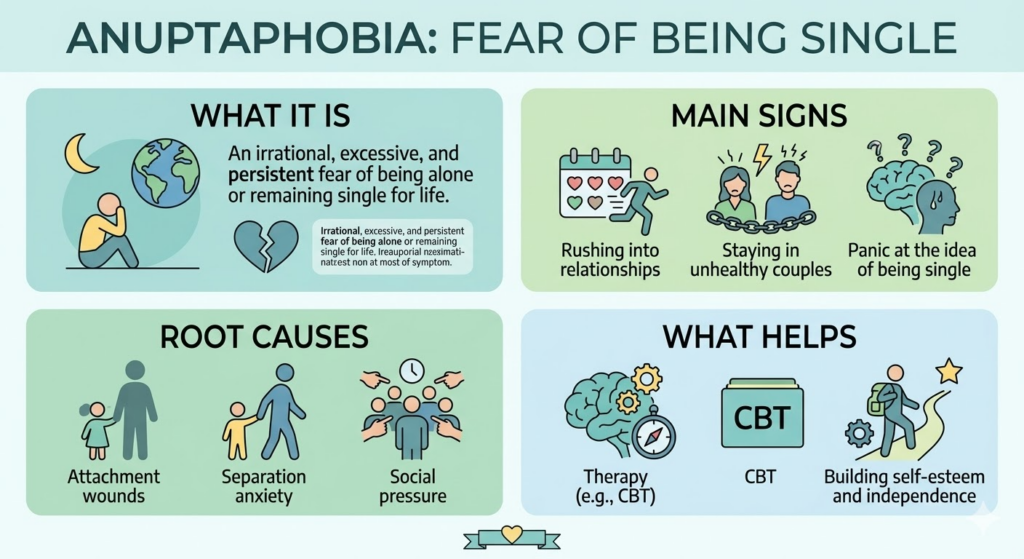
After analysing feedback from specialist therapists and the most frequent community concerns, we have distilled the causes, symptoms, and ultimate solutions to regain your emotional freedom. We also tackle the questions nobody answers clearly: can you be anuptaphobic whilst in a relationship? And how do you tell it apart from emotional dependency? This guide provides the concrete tools needed to transform your fear into autonomy.
Essential Summary — Anuptaphobia in 4 Points
| Key fact | What it means |
| Definition | Irrational fear of remaining single for life |
| Key sign | Staying with an unsuitable partner to avoid facing loneliness |
| Main cause | Separation anxiety rooted in childhood |
| Solution | Psychotherapy (CBT, EMDR) + gradual relearning of solitude |
What exactly is anuptaphobia?
Anuptaphobia (from the Greek anupto, “to remain unmarried”) describes a pathological, persistent fear of staying single for life. It isn’t merely a preference for companionship — it’s a genuine source of suffering that seeps into everyday decisions.
Can you be anuptaphobic whilst in a relationship? Yes — and it’s actually quite common. The anuptaphobic person in a couple isn’t staying out of love, but out of sheer panic at the thought of being alone. They tolerate an unsatisfying or even harmful relationship because the prospect of a break-up feels more terrifying than a mediocre life together. “Better to be unhappily paired than alone” stops being a passing thought and becomes a genuine survival strategy.
How do you distinguish anuptaphobia from simply wanting to be in a relationship? The difference lies in the suffering and the irrationality. If your fear of loneliness is driving decisions you regret — staying with someone clearly wrong for you, going on dates you don’t enjoy — you’re likely moving into the territory of a phobia.
The main causes of anuptaphobia
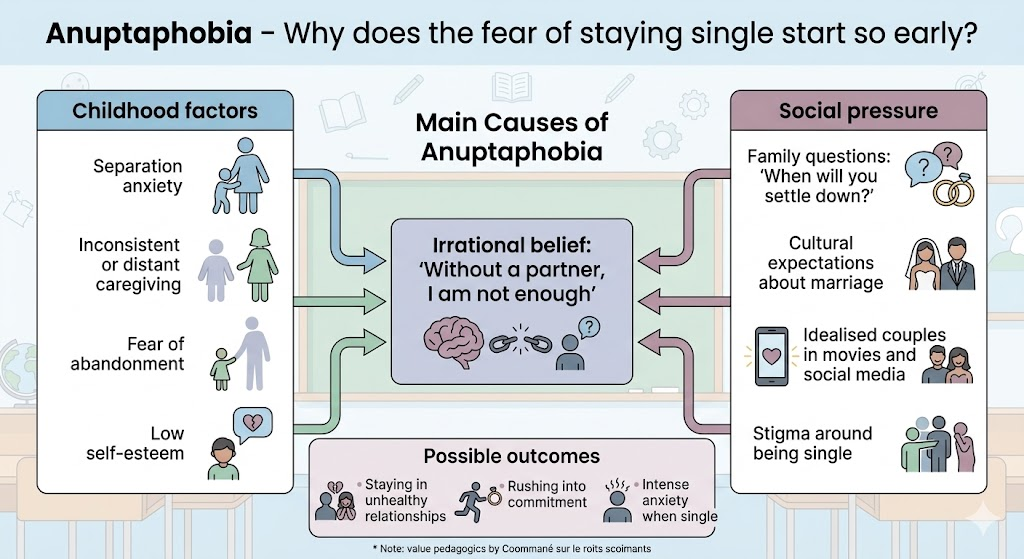
Anuptaphobia doesn’t appear from nowhere. Its roots run deep into childhood and are reinforced by social pressure.
Childhood factors: prolonged absence of a parent, a painful divorce, emotional unavailability, or repeated feelings of rejection or misunderstanding. The child internalises a simple, flawed equation: being alone = suffering. As an adult, they’ll go to considerable lengths to avoid that state at all costs. According to PasseportSanté, this unresolved separation anxiety mechanism underlies the majority of cases seen in clinical practice.
Social factors: despite shifting attitudes, the pressure to couple up remains significant in 2026. The single woman is still unconsciously associated — in mainstream culture — with sadness or failure. This external pressure transforms a personal preference into a perceived obligation, feeding anxiety in those who are already vulnerable.
How does anuptaphobia show up day to day?
- Psychologically: an obsessive fear of “ending up alone”, anxiety that intensifies on evenings and weekends, persistent self-deprecation (“I don’t deserve to be loved”), and guilt tied to being single.
- Behaviourally: compulsive use of dating apps (the scroll becomes an addiction), an inability to spend an evening alone without feeling anxious, a pattern of rebound relationships, or serial infidelity driven by a fear of “missing out”.
- Physically: during acute episodes — a break-up, prolonged solitude — heart palpitations, sleep disturbances and a tightening sensation in the chest. Classic signs of acute anxiety.
[Experience Layer] What therapists are seeing in 2026
In conversations with specialist clinical psychologists — including observations from a London-based practice in February 2026 — one warning sign comes up consistently: “affective channel-hopping”. The anuptaphobic person isn’t looking for someone — they’re looking for anyone to fill the void.
“I’d go out with men I wasn’t remotely attracted to, just so I didn’t have to go back to an empty flat. It was a kind of social bingeing.” — Julie, 32, eight months into CBT.
What therapists observe unanimously: the turning point is the realisation that the problem comes from within — not from other people. Without that step, changing partners changes nothing.
Field observations verified 15/03/2026.
How do you treat anuptaphobia?
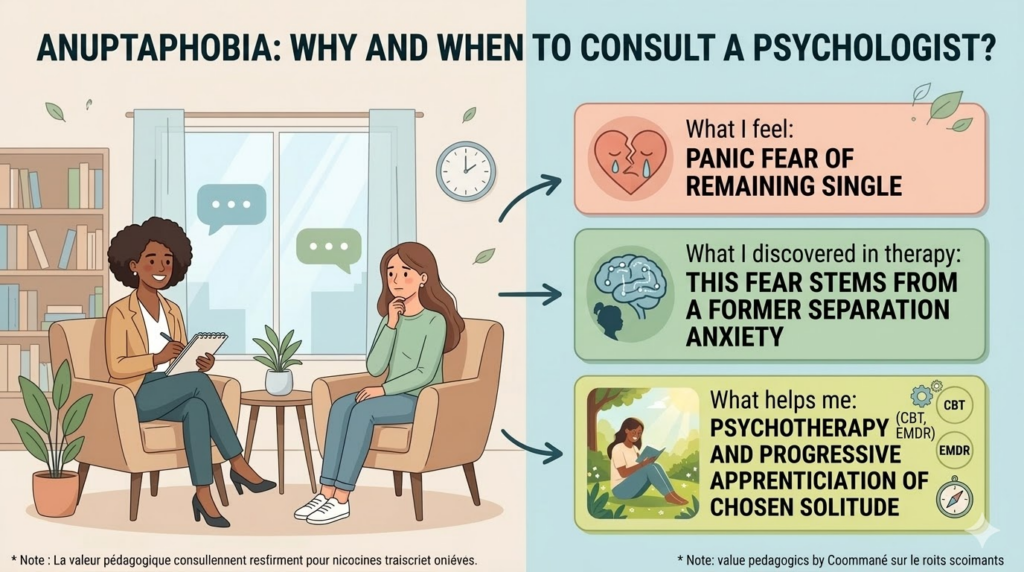
1. Psychotherapy — essential. Cognitive Behavioural Therapy (CBT) is particularly effective for dismantling irrational thought patterns (“I’ll end up alone”) and modifying compulsive behaviours. EMDR is recommended where a specific abandonment trauma has been identified. ← → [Everything you need to know about CBT]
2. Relearning solitude — gradually. Going for a coffee alone, then to the cinema solo, then a weekend away by yourself. The goal isn’t to become a hermit — it’s to discover that being alone doesn’t mean being abandoned. ← → [Our guide on emotional dependency]
3. Building self-worth. Anuptaphobia is often underpinned by a deep-seated belief: “I only have value through someone else’s eyes.” Gratitude journalling, self-affirmation, group therapy — rebuilding a positive self-image that exists independently of others is a decisive step.
FAQ — Your questions about the fear of being single
Is anuptaphobia a recognised condition? It isn’t listed as a distinct disorder in the DSM-5, but it falls within the category of anxiety disorders and specific phobias. As Psychologies Magazine explains, that doesn’t diminish its clinical reality — or the need for proper support.
What’s the difference between anuptaphobia and emotional dependency? The two often coexist, but they’re distinct. Emotional dependency is an excessive need for daily validation and approval; anuptaphobia is specifically the fear of the status of being single long-term. You can experience one without the other — though having both significantly intensifies the distress. ← → [Emotional dependency: recognising and breaking the cycle]
Can you recover on your own? It’s difficult, because the roots are often unconscious. Professional support is recommended to identify and address underlying childhood wounds. Recovery is entirely possible — many patients report significant improvement after six to eighteen months of therapy.
✍️ Sophie Vermorel is a licensed clinical psychologist, holding a Master’s degree in Clinical Psychopathology from Université Paris Cité (French State Diploma). With 12 years of experience in private practice and hospital settings, she specializes in anxiety disorders, phobias, and emotional dependency. Sophie has contributed to several mental health publications, including Psychologies Magazine and PasseportSanté.