
Growing your hair : what really works and what’s a waste of money

You typed “natural hair growth recipe” into the search bar one lazy evening, quietly comparing your ponytail to your colleague’s, who seems to gain ten centimeters without even trying.
We’ve all done it.
You open eight tabs, write down a list of ingredients, order a miracle oil that costs more than expected, and three months later, nothing has really changed.
It’s not that you did it wrong.
It’s that the original promise was false.
So we’re going to do things differently here.
No miracles, no method that “transforms your hair in 30 days.”
Just what science really knows about hair growth, what helps a little, what does absolutely nothing, and why the money spent on certain bottles is often money down the drain.
What science says about hair growth speed
First, a figure that helps put expectations into perspective.
Hair grows by an average of 0.5 to 1.7 centimeters per month, according to data compiled by the Tricho Logical Society and reported by Medical News Today.
In other words, even in the best-case scenario, you’ll gain barely two centimeters in eight weeks.
This rate is controlled by your hair follicle, genetics, age and hormones factors that no oil applied to the surface of your hair can reprogram.
And that’s the part no one tells you about those overpriced creams: nothing you put on the hair shaft can speed up growth at the root.
The follicle does its job at its own pace, underneath the skin, far beyond the reach of your hairbrush.
However, there is one real variable you can control.
We’re getting there.
The real natural hair growth recipe is to break less
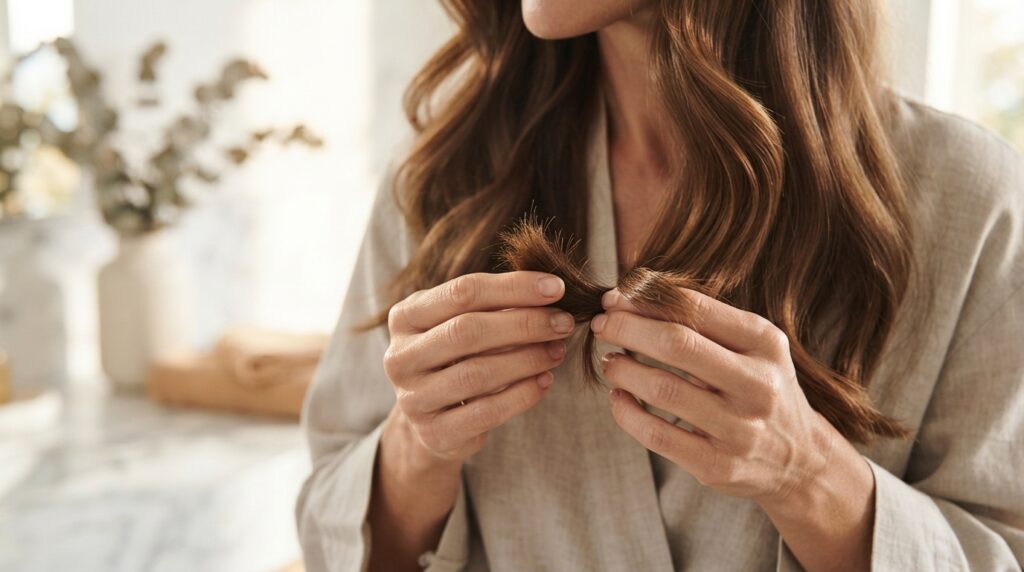
Here’s the mental shift that changes everything. You can do almost nothing to make your hair grow faster. But you can do a lot to make it break less.
And visually, the result is exactly the same: hair that looks longer, fuller and healthier.
In practical terms, hair that grows one centimeter per month but breaks every ten centimeters will never grow beyond ten centimeters.
Meanwhile, hair that grows at the same speed but is protected from breakage can reach the end of its natural cycle, sometimes several years later.
The real natural hair growth recipe, in short, isn’t a magical ingredient.
It’s a combination of small habits that reduce breakage: gentle brushing, limited heat and less friction at night.
Let’s take them one by one.
The comb test, tonight
Before going to bed, brush your lengths starting from the ends, not the roots.
Look at how many hairs are left in the brush. Repeat the test in a month after changing just one habit, such as your pillowcase.
You’ll see the difference for yourself, without having to take anyone’s word for it.
Castor oil : what it really does and what it doesn’t
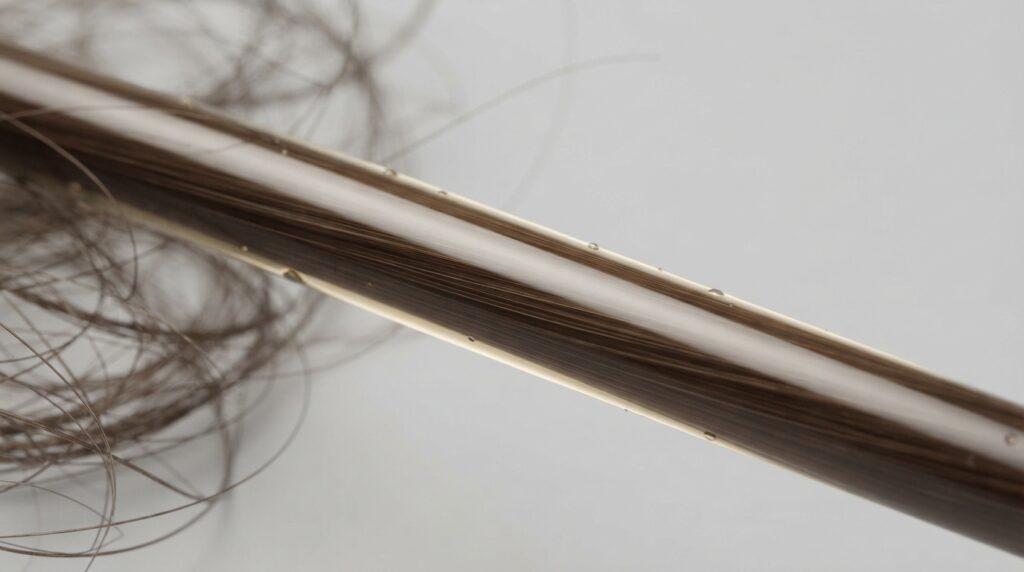
Castor oil has been the star ingredient in “hair growth” videos for the past ten years.
And honestly, it deserves to be looked at with nuance rather than dismissed outright.
A narrative review published in Cureus in February 2026 separates what has been demonstrated from what is still limited to laboratory research.
When it comes to shine and the appearance of the hair shaft, the evidence is there: castor oil increases the contrast and visible shine of the hair, providing a genuine conditioning effect.
However, when it comes to actually speeding up hair growth, the authors are clear : the effects observed with ricinoleic acid remain preclinical, tested under laboratory conditions, with no strong clinical evidence in humans to date.
So no, castor oil won’t make your hair grow twice as fast.
But yes, it can coat the hair shaft, reduce friction and therefore indirectly reduce breakage, bringing us back to the real variable mentioned above.
Used as a mask once or twice a week on the lengths, it’s a reasonable step.
Used in the hope of achieving a miracle at the roots, it’s money thrown out the window.
Scalp massage : a small gesture that matters more than you think
Here, the science is more encouraging, provided we don’t exaggerate the results either.
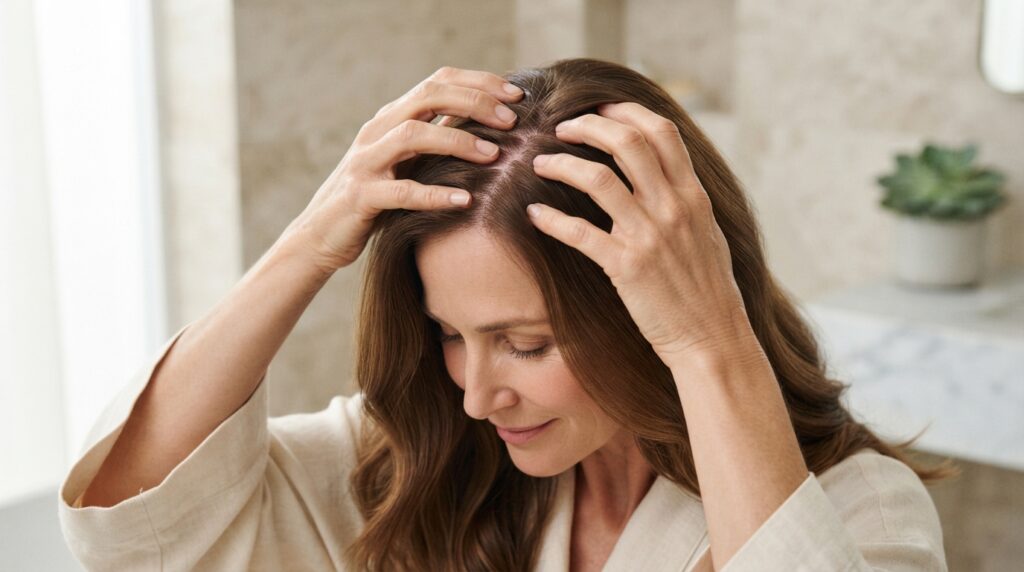
A Japanese study published in the journal Eplasty followed nine men who received four minutes of standardized scalp massage every day for twenty-four weeks.
The result : hair thickness increased measurably on the massaged side compared with the untreated side.
What this means in plain English
The massage did not increase the actual rate of hair growth.
However, it mechanically stretched the cells at the base of the follicle, which stimulated thicker hair.
And thicker hair makes the overall head of hair look fuller, even without adding a single extra centimeter.
The sample was small, only nine people so we should remain cautious about the actual size of the effect. But the gesture itself costs nothing and takes four minutes.
Your evening massage, while waiting for shampoo day
Using your fingertips, not your nails, make small circular movements across your entire scalp for three to four minutes, before or during your shampoo.
There’s no need to press hard : the pressure should be firm but comfortable.
Do it three to four times a week if you want it to make a meaningful difference.
Sleep and diet : the quiet allies of your natural hair growth recipe

We often forget about these two because they can’t be sold in a bottle.
Yet an older study that is still frequently cited, conducted by researchers Gottesman and Hamon, found that 48 hours of sleep deprivation resulted in a 19% decrease in beard hair growth among ten men studied.
Hair is not exactly the same tissue, but the underlying mechanism of an organism under stress redirecting its energy elsewhere rather than toward growth remains consistent with what is observed in dermatology.
When it comes to diet, a systematic review published in 2025 in the journal Nutrition and Health compiled seventeen studies on the relationship between diet and hair health.
The central message: hair is made almost entirely of keratin, a structural protein, which makes protein and essential amino acid intake important for its production.
The researchers also note that regular consumption of soy and cruciferous vegetables is associated with better hair health, while excessive alcohol and sugary drinks appear to work against it.
Nothing spectacular, but an overall balanced diet provides a more favorable foundation than a chaotic eating pattern.
And no, that doesn’t mean you should take supplements blindly based on an article you found online.
If you’re losing handfuls of hair, this isn’t a beauty-routine issue. It’s something to discuss with a doctor, and we won’t go further into it here.
The satin pillowcase : the detail that can change everything at night

This is probably the most underestimated habit of all, and yet one of the simplest.
TRI Princeton, a research institute specializing in hair science, measured the coefficient of friction between the hair fiber and different fabrics.
The resul t: silk generates significantly less friction with hair than cotton.
And less friction during seven or eight hours of sleep every night means fewer micro-breaks, less frizz in the morning and ends that become damaged more slowly.
Cotton, on the other hand, has a texture that catches on the hair cuticle, the outer scaly layer that protects the hair fiber.
With every head movement during the night, these scales rub against the fabric, lift and eventually break.
Over an entire year of nights, the difference adds up.
Check your pillowcase
Look at the material of your current pillowcase.
If it’s standard cotton, try a satin pillowcase for three weeks without changing anything else in your routine.
Simply observe the condition of your ends and how much hair you find on your pillow in the morning.
Your evening routine, big-sister version

So what does a real natural hair growth recipe look like once you strip away the marketing?
It looks like this: gentle brushing that starts at the ends, a few minutes of scalp massage two or three times a week, an occasional castor oil mask to coat the hair shaft, a satin pillowcase already sitting somewhere in your linen drawer, and a plate that isn’t limited to coffee and chips in front of Netflix.
Except no one is going to sell you this routine in a sponsored story, because it doesn’t make anyone any money.
It simply requires a little consistency, not a three-figure budget.
And maybe that’s the real difference between your colleague’s hair and yours: less about luck, more about habits maintained over time.
Your monthly check-in
Take a photo of your hair tonight under the same lighting you normally use.
Choose just one habit from this article : the massage, the pillowcase or brushing from the ends and stick with it for thirty days.
Take another photo.
Compare the two, without judging yourself.
To explore further on LBC
- Six tips for getting very long, healthy hair
- Personal development on LBC
- INTERNAL LINK TO CHOOSE — topic: social comparison and self-esteem