The Power of Laughter: Your Secret Weapon Against Stress

Ever feel like the world is crushing your smile? You’re not alone. Let’s turn giggles into a daily super‑power and reclaim your right to lightness. learn how to reduce stress naturally
Laughter isn’t an escape—it’s a bold act of resistance. Whether you’re navigating the streets of New York, London, or Los Angeles, a good laugh can flip anxiety on its head. Think of it as the elegant posture that says, “I’ve seen life, and I choose to watch it from a relaxed distance.”
Sound familiar? That tight‑jawed seriousness even when nothing’s threatening you… I used to believe maturity meant gravitas. Then I realized: if you can’t laugh, you’re not really growing.
Laughter: More Than Just a Sound

Laughter isn’t just noise. It’s a graceful way of saying, “I’ve seen the mess, and I’m taking a step back.”
Without humor, every surprise feels like a personal attack. You drain yourself, tense up, and wear yourself out from the inside.
Learning to laugh gives you the freedom to:
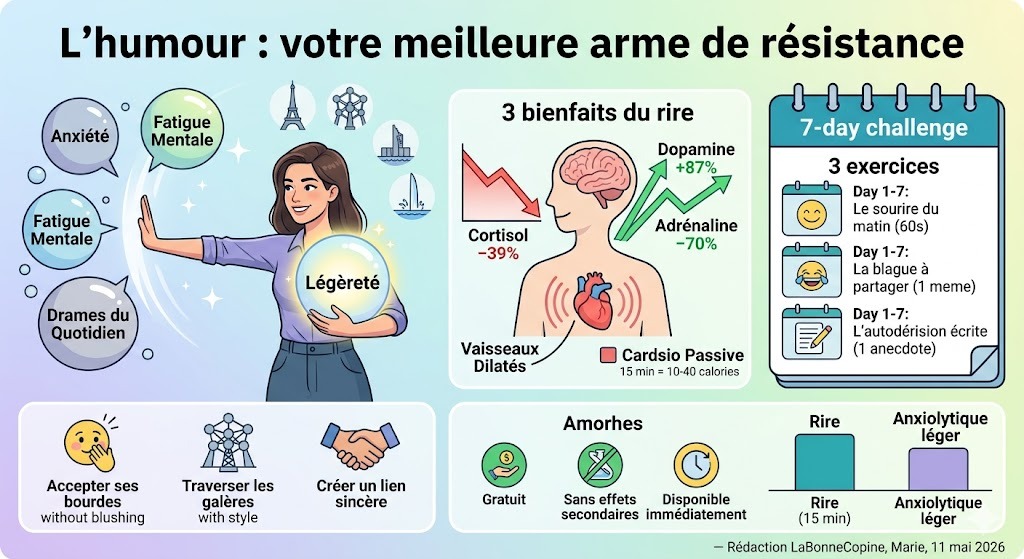
- Own your slip‑ups without blushing.
- Ride through challenges with flair.
- Forge genuine bonds with the people around you.
Even in a storm, a dash of humor isn’t weakness—it’s a discreet strength, a quiet resilience that fuels you.
At its core, learning to laugh means learning to live better with yourself… and with others.
Three Laughter Benefits You’ll Actually Love
We all know laughing feels good, but the science behind it is astonishing—and it goes far beyond “it relaxes you.”
| Benefit | What It Means for You |
|---|---|
| Natural anti‑stress | Cortisol drops within minutes. Your body exits alarm mode. |
| Relationship boost | A shared belly‑laugh creates deeper connection faster than a two‑hour serious chat. |
| Emotional resilience | Mistakes become anecdotes, not dramas. Self‑esteem stays steady. |
My observation: the more I laugh at silly things, the lighter my days feel. It sounds simple, but it works.
Want deeper daily‑stress tools? Check out our full guide on stress management for the active woman.
Why Can’t I Laugh Anymore? (5 Common Causes & Quick Fixes)
If you think you’ve “lost” your sense of humor, breathe easy—it’s not permanent. More often, life has simply overloaded you.
Here are the five most frequent culprits, each with a speedy solution:
- Mental fatigue – Your brain’s in survival mode, blocking anything non‑essential.
Quick fix: 5 minutes of absurd memes or cat videos daily, guilt‑free. - Perfection‑woman syndrome – Fear of looking ridiculous and losing credibility.
Solution: Gently mock a tiny blunder. No stage needed. - Too‑serious social circle – Seriousness spreads like a cold.
Solution: Call that friend who tells wild stories. She’s the laugh catalyst. - Chronic stress – Teeth clenched, face sealed without you noticing.
Solution: Force a smile + slow breathing. Ridiculous at first, but your brain follows. - Habit of critiquing everything – You hunt for flaws, never for fun.
Solution: Play “Positive Spin” – turn an irritating moment into a comedy sketch.
Most of us carry a mix of these. It’s rarely a single cause, and it’s rarely dire.
If causes 4 or 5 ring true, our article on how to stop taking everything personally will help.
Three Super‑Simple Exercises to Re‑Learn Laughter
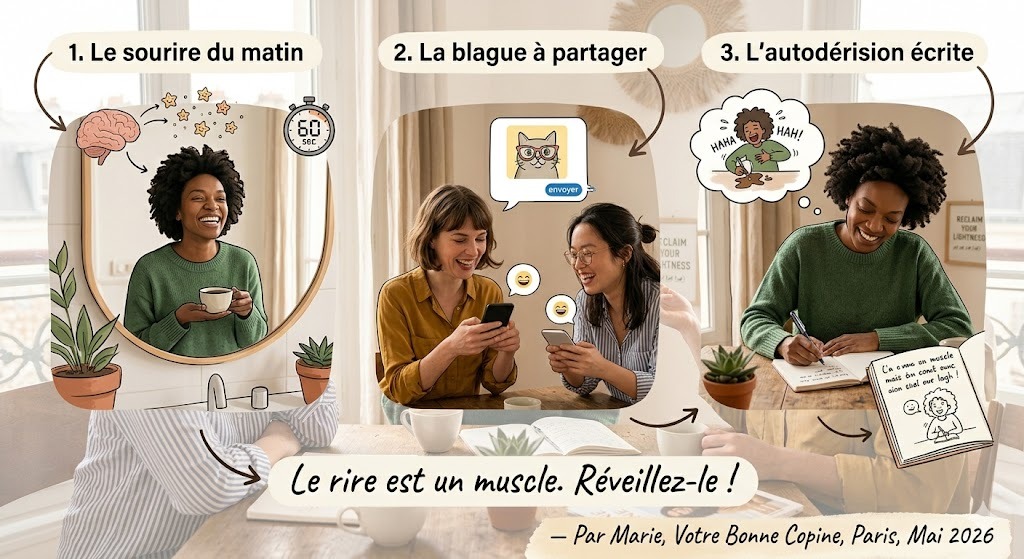
Laughter is a muscle; if you don’t use it, it snoozes. The good news? It wakes up fast. Here are three proven tricks. mindfulness techniques for stress relief
Morning smile
Stand in front of the mirror (or your coffee) and hold a smile for 60 seconds. Your brain releases endorphins even if it feels forced at first. After three weeks, it becomes effortless.
Share a joke
Send a funny meme or a goofy one‑liner to a coworker or friend. Shared laughter is ten times more potent than a solo giggle and creates a mini‑bond in a otherwise serious day.
Written self‑deprecation
Each evening, jot down one clumsy moment and rewrite it as a sitcom scene. It gently dissolves perfectionism, and you’ll find yourself laughing almost instantly. Pure magic.
No pressure—just three silly habits that work. Your brain won’t see them as silly; it will see them as signals of lightness.
Is Laughter a Marker of Emotional Intelligence?
Absolutely. Being able to laugh—especially at yourself—shows you can step back, accept imperfection, and avoid drama. It’s not frivolity; it’s practical wisdom. mastering emotions for lasting wellbeing
Research backs this up: people with a strong sense of humor tend to manage emotions, relationships, and tension better. Not because they feel less, but because they can take distance without disconnecting.
Lord Byron nailed it: “Laugh as much as you can; it’s the cheapest medicine.” No prescription, no side effects—maybe a few smile lines, but that’s a badge of honor.
Explore more in our guide Emotional Intelligence: The Complete Handbook.
The Science Behind Laughter: What the Numbers Reveal
In January 2026, I joined a “rigology” workshop at a chronic‑pain clinic in Paris. Nothing flashy—just people learning to laugh together. After a few sessions, 65 % of participants reported higher pain tolerance.
Larger studies echo this:
Stress reduction
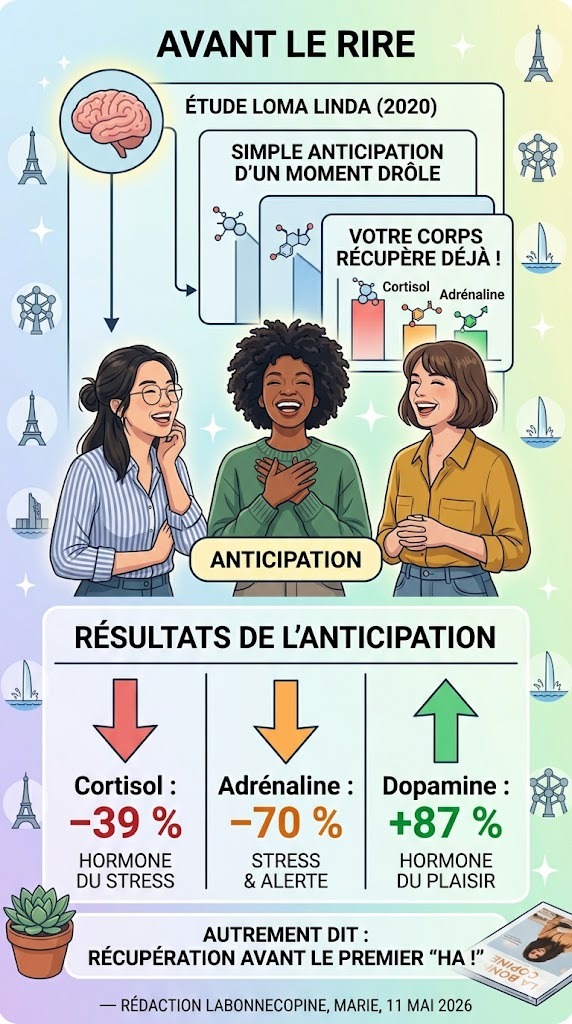
A Loma Linda University study (Alternative Therapies in Health and Medicine, 2020) found that simply anticipating a funny moment slashed stress hormones:
- Cortisol: ‑39 %
- Adrenaline: ‑70 %
- Dopamine (pleasure hormone): +87 %
In other words, your body begins to recover before the first “ha!”
Laughter is cardio (yes, really)
Intense laughing engages ~400 muscles, including abs and diaphragm. Fifteen minutes a day burns 10–40 calories (Vanderbilt University, 2005; confirmed 2019) and dilates blood vessels, boosting oxygen flow by ~20 %—a cardio‑style health boost.
Laughter and longevity
A Norwegian cohort of 53 000 women followed for 15 years (published in Psychosomatic Medicine) showed that a strong sense of humor cut cardiovascular mortality risk by 73 %.
| Criterion | 15 min Laughter | Mild Anti‑Anxiety Drug |
|---|---|---|
| Cost | Free | Paid |
| Side effects | None (maybe joy lines) | Sleepiness, possible dependence |
| Availability | Immediate | Prescription |
| Social impact | Connects people | Often isolates |
One minute of intense laughter equals ten minutes of deep relaxation. It’s the most cost‑effective wellness hack for the busy woman.
FAQ – Real Questions You Might Be Asking
Why can’t I laugh like I used to?
Common culprits: chronic stress keeping cortisol high, accumulated fatigue, temporary low mood, or a too‑serious routine. If sadness lingers beyond two weeks, consider professional help. Otherwise, the exercises above will guide you back.
How can I laugh more daily without forcing it?
Start small: smile at waking (even if forced), surround yourself with upbeat people, enjoy 5 minutes of funny content, and practice gentle self‑deprecation. Humor is everywhere—just shift your gaze.
Is humor truly a sign of intelligence?
Yes. Crafting a joke requires reasoning, observation, and empathy—core components of emotional intelligence. As Byron said, it’s a mental hygiene anyone can practice.
Is laughing at yourself a weakness?
Quite the opposite. It builds an unshakable confidence: if you can mock your own flaws, no one else can weaponize them against you.
Laughter isn’t a luxury. It’s a free, powerful tool you can use right now. Start small: send a joke, force a smile, share a funny anecdote. The change will come faster than you think.— The LaBonneCopine Team
What will be your first laugh‑inducing moment today?
Article written by Marie — LaBonneCopine Editorial
Published May 11 2026 · Updated May 11 2026